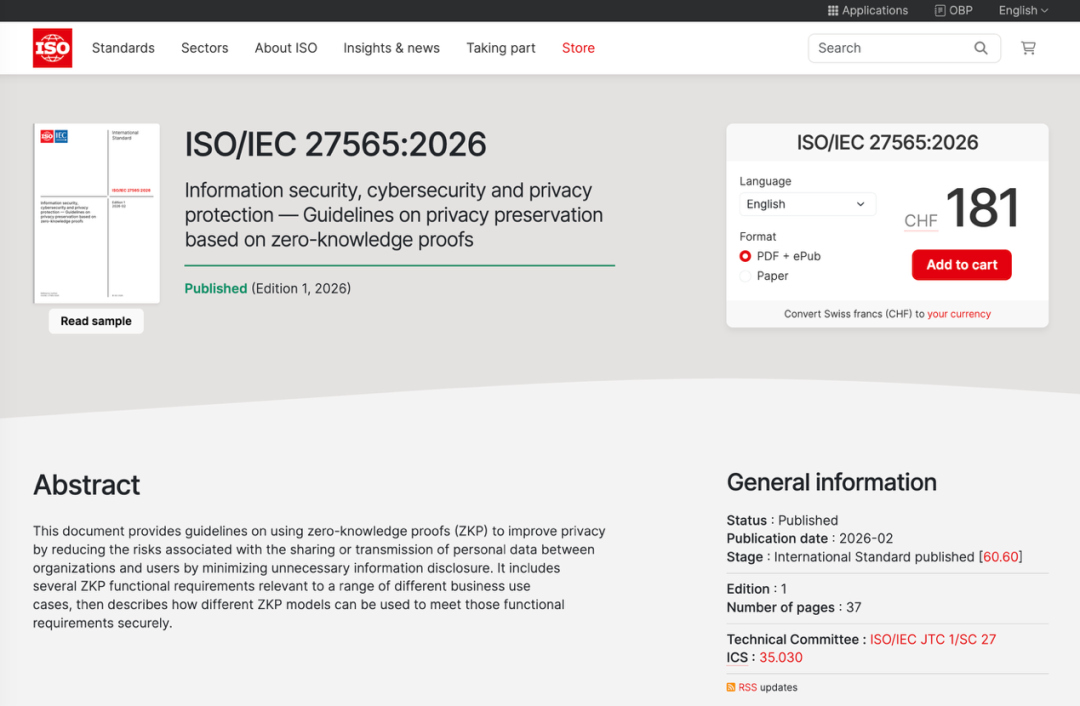
Recently, the International Organization for Standardization (ISO) officially released ISO/IEC 27565:2026, titled “Information Security, Cybersecurity and Privacy Protection — Guidelines on Privacy Preservation Based on Zero-Knowledge Proofs.” The standard was led by the team of Professor Ren Kui, Executive Deputy Director of the State Key Laboratory of Blockchain and Data Security at Zhejiang University, with Associate Professor Zhang Bingsheng serving as the principal contributor. This marks the first international standard in the field of zero-knowledge proofs proposed by China and represents a significant milestone in ISO’s standardization efforts for zero-knowledge proof technologies.

As an emerging cryptographic technique, Zero Knowledge Proof (ZKP) is increasingly being applied in areas such as privacy protection and data security. However, the absence of unified technical standards has created barriers to real-world deployment and introduced potential security risks. To address these challenges, the standardization project was initiated on November 18, 2021, within ISO/IEC JTC 1/SC 27 Working Group 5, and took a total of four years and three months to complete.
As one of the world’s highest-level international standardization bodies, ISO’s newly released standard provides a set of guiding principles for enhancing privacy through the use of ZKPs. Its core objective is to minimize unnecessary information disclosure, thereby reducing the risks associated with sharing or transmitting personal data between organizations and users. The document specifies a range of ZKP functional requirements applicable to various business scenarios and further explains how different ZKP models can be used to securely meet these requirements.
The publication of ISO/IEC 27565:2026 is expected to provide important guidance for the standardized adoption and secure deployment of privacy-enhancing technologies worldwide.