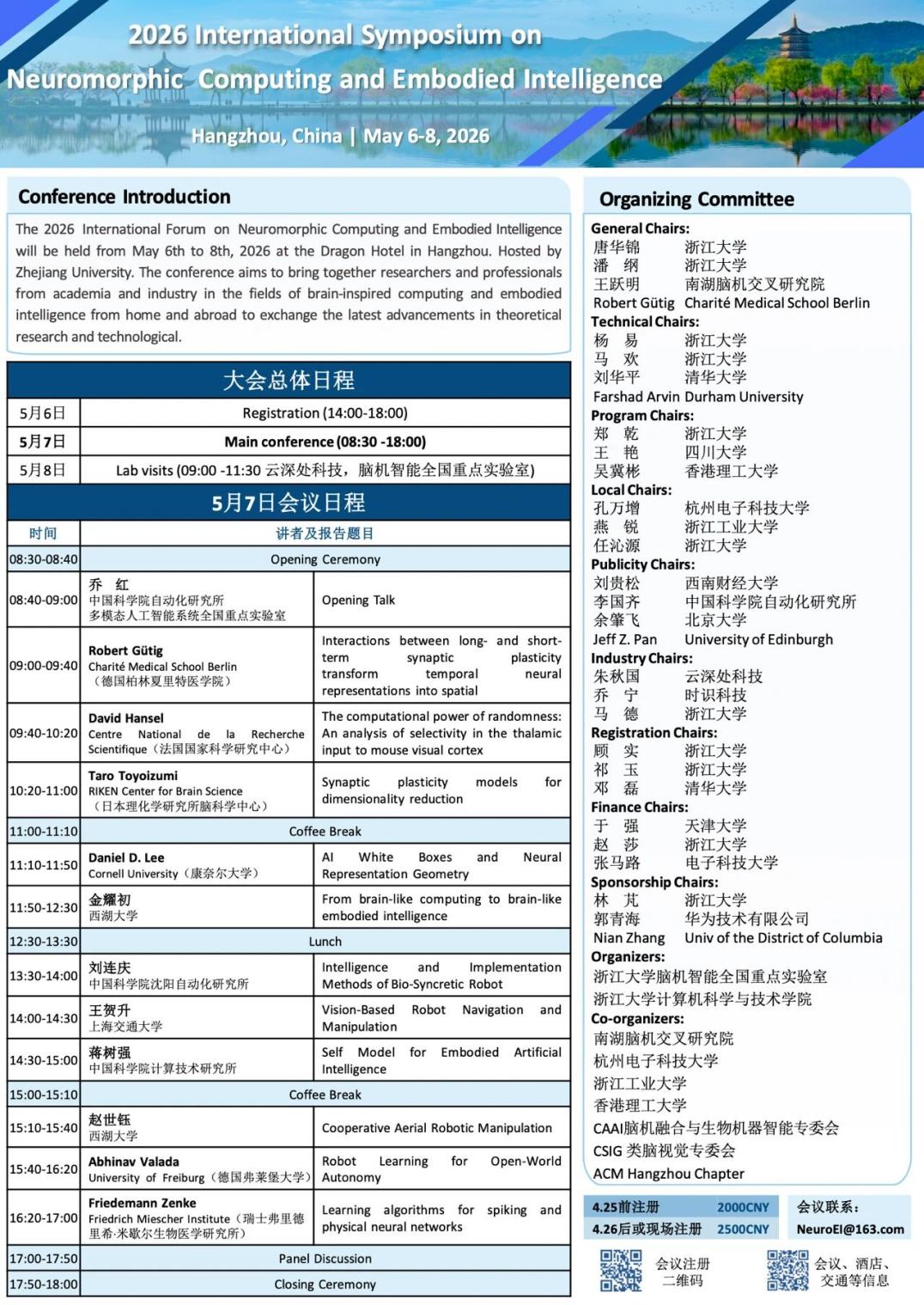
May 6-8, 2026
The Dragon Hotel, Hangzhou, China
(No.120, Shuguang Road, Hangzhou)
CONFERENCE THEME
With the continuous advancement of neuroscience in exploring the brain's cognitive mechanisms, coupled with the rapid development of robotics, perceptual computing, and optimization algorithms, the intersection of brain-like computing and embodied intelligence has entered a critical phase of development. How to translate the brain's information processing mechanisms into efficient intelligent algorithms, how to achieve adaptive interaction between embodied systems and complex real-world environments, and how to promote the deep integration of brain-inspired embodied intelligence theory research with engineering applications have become core issues of common interest in both academia and industry.
This forum aims to bring together leading experts and young scholars from both domestic and international fields of brain-like computing and embodied intelligence to engage in in-depth discussions on cutting-edge theories and key technologies in the field. The topics covered by the forum are broad, including foundational theoretical advances in brain-like computing such as synaptic plasticity and neural representation geometry, as well as core technological breakthroughs in embodied intelligence, including biomimetic robotics, visual perception, and robotic manipulation. The goal is to promote the deep integration of theoretical research with practical applications.
CONFERENCE ORGANIZATION
Organizers
State Key Laboratory of Brain-Machine Intelligence, Zhejiang University
College of Computer Science and Technology, Zhejiang University
Co-organizers
Nanhu Brain-Machine Interface Cross-Disciplinary Research Institute
Hangzhou Dianzi University
Zhejiang University of Technology
The Hong Kong Polytechnic University
CAAI Technical Committee on Brain-Machine Fusion and Bio-Machine Intelligence
CSIG Technical Committee on Brain-Inspired Vision
ACM Hangzhou Chapter
Conference Chairs
Huaijin Tang, Zhejiang University
Gang Pan, Zhejiang University
Yueming Wang, Nanhu Brain-Machine Interface Cross-Disciplinary Research Institute
Robert Gütig, Charité Medical School Berlin
Conference Schedule
May 6Registration (14:00–18:00)
May 7Main Conference (8:30–18:00)
May 8Lab Visits (9:00–11:30) – Deep Robotics & the State Key Laboratory of Brain-Machine Intelligence
KEYNOTE SPEAKERS
Opening Talk
Qiao Hong is an academician of the Chinese Academy of Sciences (CAS), a professor at the Institute of Automation, CAS, and the director of the National Key Laboratory of Multimodal Artificial Intelligence Systems. She is an IEEE Fellow and has made pioneering contributions in the fields of robotics theory and applications, particularly in humanoid robot decision-making, perception, control, and structural design. She has received several prestigious awards, including the Second-Class National Natural Science Award and the First-Class Beijing Science and Technology Award. Qiao serves as the editor-in-chief of Robotic Intelligence and Automation and holds associate editor roles at several prominent international journals, including IEEE T-NNLS and T-CYB. She has also served on the IEEE Robotics and Automation Society’s Board of Governors and the IEEE Fellow Review Committee.
1.Interactions between long- and short-term synaptic plasticity transform temporal neural representations into spatial
Robert Gütig is a computational neuroscientist at the Charité Medical University of Berlin and the Berlin Institute of Health. He holds a lifetime professorship in neural learning and mathematical modeling (W3). His research focuses on pulse-based brain information processing and learning mechanisms, with particular emphasis on action potential timing, sensory representation, and synaptic plasticity. His work has been published in Science and Nature Neuroscience.
2.The computational power of randomness: An analysis of selectivity in the thalamic input to mouse visual cortex
David Hansel is a senior researcher at the French National Centre for Scientific Research (CNRS) and a visiting scientist at the Edmond and Lily Safra Brain Science Center, Hebrew University of Jerusalem. A theoretical neuroscientist, he co-leads the CNRS Brain Dynamics, Plasticity, and Learning Lab. His research has been published in Neuron and Nature Human Behaviour.
3.Synaptic plasticity models for dimensionality reduction
Taro Toyoizumi is the director of the Neural Computation and Adaptation Laboratory at the RIKEN Brain Science Institute in Japan. His research spans computational and theoretical neuroscience, focusing on neural coding, synaptic plasticity, learning, adaptation, and neural circuit dynamics. He currently serves as the editor-in-chief of the international journal Neural Networks.
4.AI White Boxes and Neural Representation Geometry
Daniel D. Lee is a chaired professor at Cornell University and the global head of AI research at Samsung Research. An IEEE Fellow and AAAI Fellow, he was previously the director of the GRASP Lab at the University of Pennsylvania. His research spans artificial intelligence, machine learning, robotics, and computational neuroscience, with over 55,000 citations on Google Scholar. His work focuses on understanding universal computational principles in biological systems and applying them to the development of autonomous systems.
5.From brain-like computing to brain-like embodied intelligence
Jin Yaochu is an academician of the European Academy and an IEEE Fellow, currently a chaired professor at Westlake University. He serves as the president of the IEEE Computational Intelligence Society and the editor-in-chief of Complex & Intelligent Systems. He was formerly the editor-in-chief of the IEEE Transactions on Cognitive and Developmental Systems. His research focuses on intelligent systems, machine learning, neural networks, and AI technologies. He has received multiple prestigious awards, including the IEEE Evolutionary Computation Journal's Best Paper Award and the IEEE Computational Intelligence Magazine’s Outstanding Paper Award. He was awarded the "Humboldt AI Chair" in Germany and the 2025 IEEE Frank Rosenblatt Award.
6.Intelligence and Implementation Methods of Bio-Syncretic Robot
Liu Lianqing is a distinguished researcher and deputy director at the Shenyang Institute of Automation, CAS. He is a recipient of the National Science Fund for Distinguished Young Scholars and its continuation projects. His research interests include micro/nanorobotics, lifelike robots, and intelligent systems. He has served as the vice president and senior consultant for the IEEE Robotics and Automation Society and as the chair of the IEEE Nanotechnology Committee's Biological Subcommittee. He is a member of the "Intelligent Robots" National Key R&D Program’s expert group.
7.Vision-Based Robot Navigation and Manipulation
Wang Hesheng is a professor at the Department of Automation at Shanghai Jiao Tong University and the dean of the Pujiang International College. A recipient of the National Science Fund for Distinguished Young Scholars, he is a leading figure in robotics, serving as the General Chair for the IROS 2025 conference. His research focuses on robot vision perception, intelligent control, and machine vision, with significant achievements in robot vision and autonomous navigation.
8.Self Model for Embodied Artificial Intelligence
Jiang Shuqiang is a researcher at the Institute of Computing Technology, CAS, and the deputy director of the Key Laboratory of Intelligent Information Processing. A recipient of the National Science Fund for Distinguished Young Scholars, his research interests include multimodal intelligence, machine learning, and computer vision. He leads the "Innovation 2030—New Generation Artificial Intelligence" major project. He has received the China Computer Federation (CCF) Science and Technology Award, the Wu Wenjun Artificial Intelligence Natural Science Award, and the Beijing Science and Technology Progress Award.
9.Cooperative Aerial Robotic Manipulation
Zhao Shiyu is a distinguished researcher and PhD supervisor at the School of Engineering, Westlake University. He is the head of the Intelligent Unmanned Systems Laboratory (WINDY Lab). His research focuses on aerial manipulation robots, multi-robot collaborative intelligence, and autonomous decision-making. He has published as a corresponding author injournals such as Nature and Nature Communications. Zhao is listed in the National High-Level Foreign Expert Program and the Stanford University’s global top 2% scientists list.
10.Robot Learning for Open-World Autonomy
Abhinav Valada is a professor at the University of Freiburg in Germany, leading the Robotics Learning Lab. His research lies at the intersection of robotics, machine learning, and computer vision, with a focus on robot perception, state estimation, and planning in complex real-world environments. He serves as the chair of the IEEE Robotics and Automation Society's Robot Learning Technical Committee. Valada has received the IEEE RAS Early Career Award (2023), the NVIDIA Research Award (2022), and the IROS Best Paper Award (2024).
11.Learning algorithms for spiking and physical neural networks
Friedemann Zenke is a computational neuroscientist and the head of a senior research group at the Friedrich Miescher Institute in Switzerland. He also holds an assistant professor position at the University of Basel. His research focuses on learning, memory, and information processing in biological spiking neural networks. His papers have been published in Science, PNAS, Neuron, and Nature Neuroscience.