The IEEE/ACM International Conference on Software Engineering (ICSE 2026) was recently held in Rio de Janeiro, Brazil. A research paper submitted by the Software Engineering team from the College of Computer Science, Zhejiang University, was awarded the ACM SIGSOFT Distinguished Paper Award.
As the world’s flagship conference in the field of software engineering, ICSE is classified as a Class A international academic conference by the China Computer Federation (CCF). The 2026 session marked the 48th iteration of this annual prestigious conference. This honour represents a remarkable achievement for Zhejiang University, as the software engineering team has secured distinguished paper awards at top-tier software engineering conferences for three consecutive years, following its successes at ICSE 2024 and FSE/ISSTA 2025.
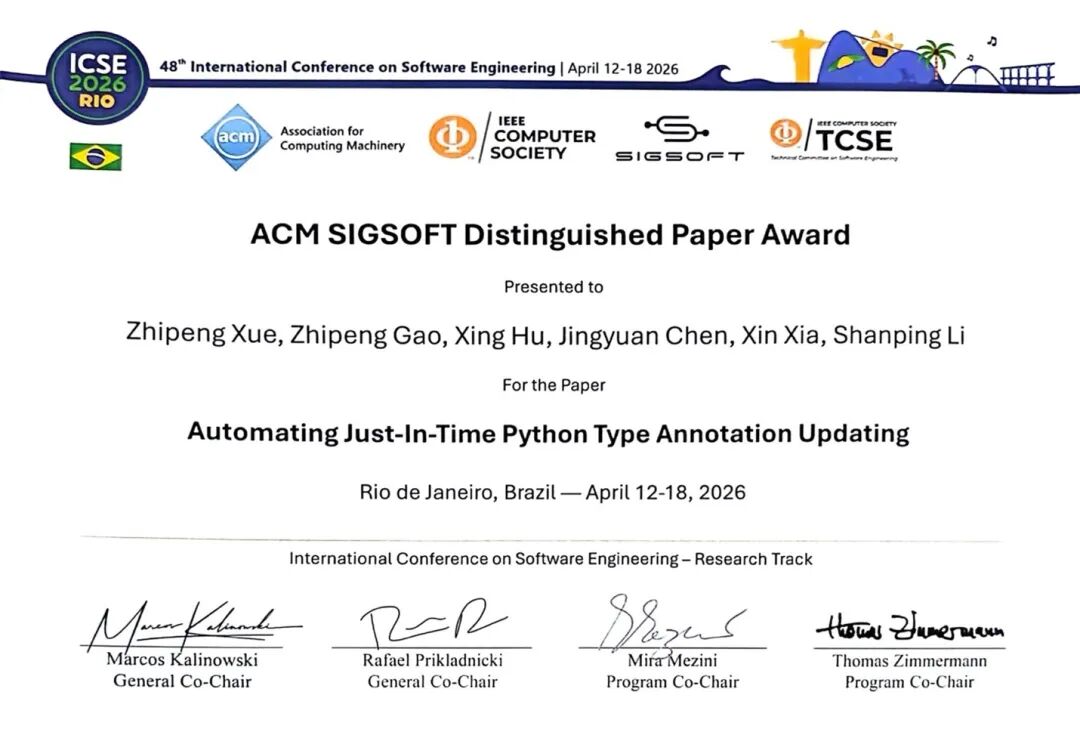
ICSE2026 Award Certificate
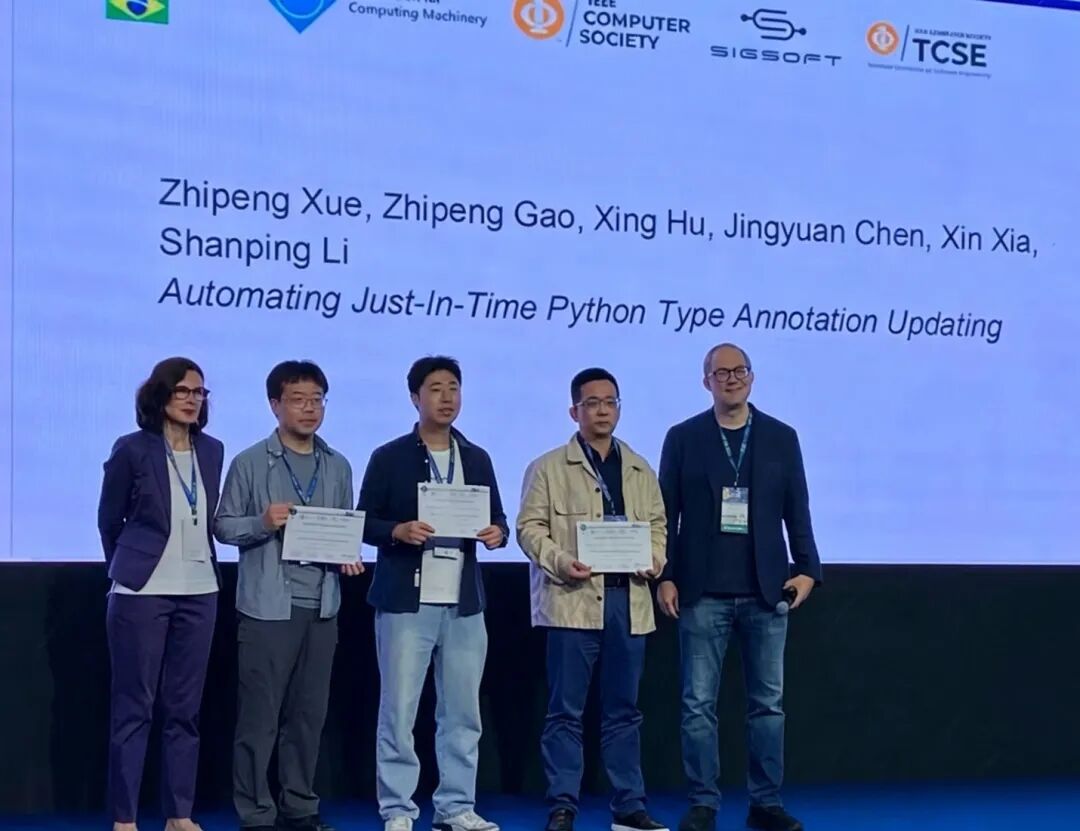
About ICSE 2026
The IEEE/ACM International Conference on Software Engineering (ICSE) stands as a premier global academic event in software engineering and a CCF Class A international conference. For decades, it has served as an authoritative platform for researchers, educators and industrial practitioners across the globe to exchange cutting-edge ideas, present innovative research outcomes, discuss industry development trends and share practical engineering experience. Constantly leading the frontier of global software engineering research, ICSE gathers top scholars and industry professionals from academia and enterprises worldwide.
ICSE 2026 received a total of 1,469 paper submissions. After rigorous peer review, only 321 papers were accepted for publication, resulting in a competitive acceptance rate of 21.85%.
Title: Automating Just-In-Time Python Type Annotation Updating
With the explosive growth and widespread application of open-source Python projects, Python has introduced the type annotation mechanism to resolve type errors triggered by its inherent dynamic typing features. Nevertheless, developers frequently overlook type annotations during source code modifications, causing persistent inconsistency and obsolescence of type annotations throughout code iteration and evolution. Outdated Python type annotations impede developers’ comprehension of program logic and may even lead to fatal program crashes in severe scenarios. Therefore, developing effective methods to update outdated type annotations in real time during software development is of great research significance and practical value.
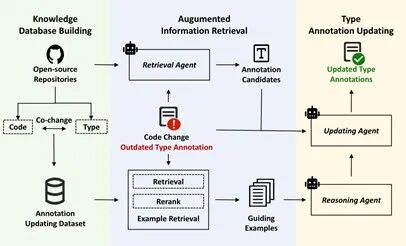
Model architecture
This paper proposes TypeUp (Type Annotation Updator), a novel just-in-time type annotation updating method built upon large language models. Leveraging existing type annotation data and corresponding code modification records, the tool can automatically generate accurate and compliant updated type annotations.
Experimental validation demonstrates that TypeUp achieves a 41.9% performance improvement compared with state-of-the-art type inference methods. In practical verification on real-world open-source projects, 20 out of 25 automatically updated outdated type annotations generated by the tool were officially adopted by project developers, fully verifying the excellent practicality and robustness of the method in real software development scenarios.
The first author of the paper is Zhipeng Xue, a third-year doctoral student. The corresponding authors are Zhipeng Gao, Hundred Talents Program Researcher, and Xin Xia, Qiushi Distinguished Professor. This research achievement was jointly completed by the College of Computer Science, the Shanghai Institute for Advanced Study, and the School of Software Technology of Zhejiang University.
DOI: https://doi.org/10.1145/3744916.3764565
The Software Engineering team of Zhejiang University College of Computer Science has delivered world-class research achievements in multiple core directions, including software analysis, software repository mining, empirical software engineering, and artificial intelligence-based software testing and analysis. The team boasts a high-caliber research and development team, yielding numerous internationally leading research outcomes, and has established mature systems for talent cultivation, academic cooperation and industrial achievement transformation.
The team maintains long-term and in-depth academic cooperation with renowned overseas universities, including Singapore Management University, Monash University and the University of British Columbia. Additionally, it has carried out fruitful industry-university-research collaborations with well-known enterprises such as Huawei, State Street Corporation and Shanghai Pudong Development Bank. Its outstanding research outputs have exerted profound influence on the domestic software industry and the global open-source community.