Recently, the team led by Professors Zhang Guofeng and Bao Hujun at the CAD&CG State Key Laboratory of Zhejiang University achieved a key breakthrough in spatial intelligence through collaborative industry-academia-research efforts. InSpatio, a company incubated by the team, announced the completion of a Pre-A funding round worth tens of millions of USD, with participation from Guanghe Capital, Shunwei Capital, and Sequoia China. The funding will inject strong momentum into the large-scale deployment and industrial expansion of its technological achievements. Professor Zhang Guofeng is the founder of InSpatio, and Professor Bao Hujun serves as chief scientist.
As the team’s core vehicle for technology transfer, InSpatio has produced strong results in both R&D and product development. Its self-developed real-time 3D model, InSpatio-WorldFM, and 4D world model, InSpatio-World, have been fully open-sourced and quickly gained broad attention and recognition from the global open-source community, developers worldwide, and industry media. Meanwhile, its flagship product—the world simulator Topos 1.0—is about to enter beta testing, further deepening the integration between its technology and industrial use cases.
On the innovation front, the team has moved beyond traditional 2D generation paradigms. Grounded in the 3D geometric structure of the physical world, it has built a unified, computable, real-time interactive, and physics-based reasoning-capable 3D spatial representation system. This breakthrough helps solve a core challenge facing agents as they enter the physical world, creating an end-to-end path from basic research to technology development to industrial application, and providing critical support for high-quality growth in the spatial intelligence industry.
Toward the Physical World: Exploring a 3D-Native World Model Route
In recent years, video models have made rapid progress in visual realism. Yet for agents that need to operate in real physical environments and make autonomous decisions and take action, modeling based solely on 2D imagery can no longer support accurate spatial understanding and stable action reasoning. Whether it is a robot navigating complex scenes, an autonomous vehicle predicting dynamic environmental changes in real time, or XR, film, and gaming applications that require interactive, editable dynamic scenes, the demands on world models are rising.
Clearly, the core mission of world models for physical AI is no longer limited to “reproducing visual effects.” They must answer three key questions: How do spatial states evolve dynamically? What spatial relationships and interaction logic exist among objects? And what physical changes will result from an agent’s specific actions? This requires models to continuously and accurately model 3D spatial structure, dynamic evolution, and underlying physical constraints—overcoming the limits of 2D representations and enabling comprehensive perception and reasoning about the physical world.
Drawing on the CAD&CG State Key Laboratory’s long-standing expertise in graphics, 3D vision, and spatial computing and intelligence, the InSpatio team focuses on the 3D-native world model route. Rather than accepting the inherent limits of 2D representations, the team builds world states from the spatial structure of the physical world, integrating view generation, motion representation, and state-change reasoning into a unified 3D framework. This enables efficient integration, precise characterization, and dynamic reasoning of 3D spatial information, laying a solid foundation for physical AI in real-world scenarios.
From Real-Time 3D Generation to Dynamic World Simulation
Previously, the InSpatio team released and open-sourced real-time 3D/4D world models such as InSpatio-WorldFM and InSpatio-World, helping world models move beyond static spatial understanding toward dynamic scene representation. The work strengthens three core capabilities: multi-view consistency, spatial structural stability, and real-time interactivity. Through an innovative technical architecture and algorithm design, it offers a new path and practical approach for agents to efficiently understand and accurately simulate the real physical world, while also providing valuable experience for further iteration and scenario expansion.
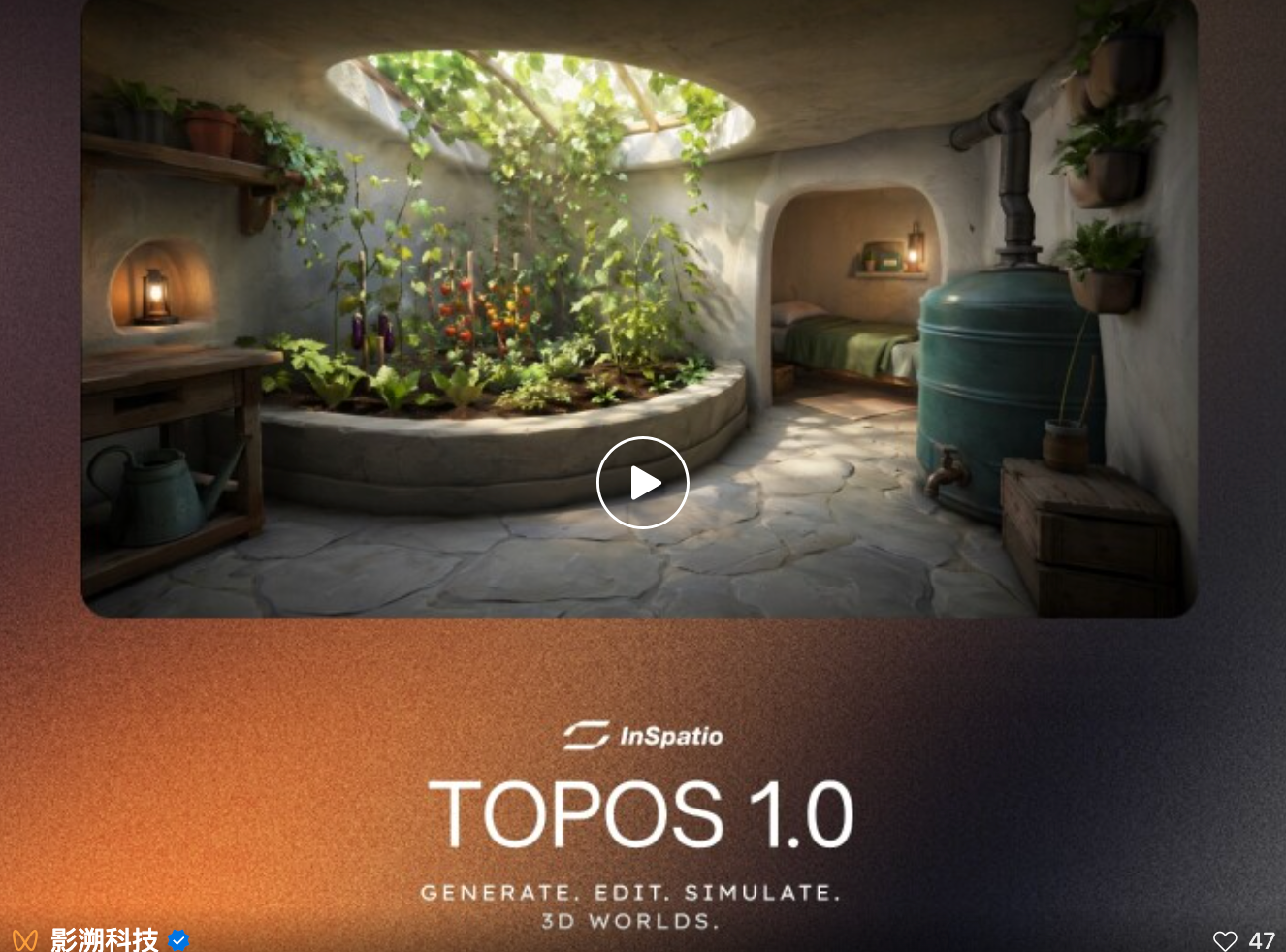
Building on this, the team has extended its work toward world simulators. InSpatio recently previewed its new world simulator, Topos 1.0, which will soon enter beta testing. Aimed at building high-fidelity, editable, and interactive simulation environments, the simulator deeply integrates the strengths of 3D world models and translates them into practical value for embodied intelligence, game development, film and television production, and other fields. It precisely addresses core needs for dynamic spatial generation and immersive interactive simulation, bringing new momentum to technological innovation and industrial deployment in these areas.
Unlike video models that focus on image generation, 3D-native world models place greater emphasis on maintaining a unified and stable spatial state. They ensure that the same object retains consistent geometry, spatial position, and attributes across different viewpoints and points in time, while also accurately reasoning about dynamic environmental changes and the consequences of an agent’s actions. This direction clearly reflects a core trend in spatial intelligence: moving beyond pure visual generation toward deeper physical-world modeling that better matches real-world needs.
Building a Closed Loop for Dynamic 3D Data and Model Training
Dynamic 3D data is increasingly recognized as a core foundation for spatial intelligence. The real world has abundant video data, but high-quality dynamic 3D data—complete with geometry, spatial scale, material properties, motion patterns, and object interactions—remains scarce. For key applications such as autonomous robot action and autonomous driving environment prediction, building reproducible, editable, and verifiable spatial states is essential for moving agents from mere perceptual observation to autonomous learning and precise decision-making.
The InSpatio team has long worked in graphics, 3D vision, and spatial computing and intelligence. With deep technical expertise, it can accurately extract spatial structure information from diverse real-world observations, including images, video, and depth-sensor data, and transform fragmented observations into standardized, learnable, editable, and reusable 3D representations. This provides a solid data and technology foundation for spatial intelligence R&D.
Around this foundation, the team continues to build a full-process data loop: real-world capture, 3D reconstruction, generative enhancement, and model-training iteration. By improving the comprehensiveness of data collection, the accuracy of 3D reconstruction, the efficiency of generative enhancement, and the rigor of model-training iteration, it has created a virtuous cycle in which data and models drive and continuously improve each other. This strongly supports efficient training of dynamic 3D world models and the deployment of physical AI in real-world scenarios.
Moving Research Toward Industrial Application
This technological breakthrough and the closing of the funding round not only demonstrate the CAD&CG State Key Laboratory’s top-tier R&D strength in spatial intelligence, but also serve as a model example of deep industry-academia-research integration in AI at Zhejiang University. To keep moving research into industrial application, the team led by Professors Zhang Guofeng and Bao Hujun has built a full-chain strategy—basic research, technical breakthroughs, and technology transfer—guided by technology iteration and industry needs. From the open-source release of real-time 3D world models, to the iterative upgrading of dynamic 4D world modeling, to the development of a world simulator for interactive simulation, the team has steadily turned cutting-edge laboratory technology into deployable, commercially viable products and solutions.
These developments fully reflect the CAD&CG State Key Laboratory’s sustained commitment to and exploration of spatial intelligence. They strengthen the foundation of basic research, break through key technical bottlenecks, and bridge the “last mile” of technology transfer, allowing cutting-edge technology to truly leave the lab and enter industrial scenarios. In the future, with funding support and accumulated technical expertise, the team will continue to deepen core technology iteration, accelerate product deployment and scenario expansion, help build a new ecosystem for the spatial intelligence industry, and ensure that frontier technology better serves the real economy.