By the Huangpu River, a new tide is rising.
The 2026 World Artificial Intelligence Conference (WAIC) and the High-Level Meeting on Global AI Governance were held in Shanghai. Global AI innovation is entering an unprecedentedly dynamic era, full of enormous opportunities.
Chen Tianrun, a PhD student in our college, brought his high-frame-rate interactive world model to the conference exhibition area. Let’s step into his story and see how a young truth-seeker is putting innovation into practice at the forefront of technology.
Where a thousand sails race and each new day brings fresh renewal, the 2026 WAIC’s wave of frontier innovation has brought forward a host of outstanding young professionals. Chen Tianrun, a PhD student in our college, is one of them. He led Moxin Technology, the company he founded, in showcasing MoWorld, a high-frame-rate interactive world model built entirely on a domestic NPU stack. He also appeared at several industry forums, where he drew on his years of entrepreneurial experience to share his thoughts on exploring frontier technology and bringing it into real-world use.
Trained on a domestic Ascend Cloud computing platform, the MoWorld 3D world model natively possesses core capabilities in 3D spatial understanding and physics-based simulation. It serves as a “super brain” connecting the virtual digital world with real industries. On a fully domestic platform, it achieves real-time inference at up to 50 frames per second and can efficiently transform 2D images into 3D scenes, even making reasonable inferences about the space behind the scene. The model can be applied to real-world scenarios such as robotic simulation training, autonomous driving, and the digitalization of cultural tourism experiences.
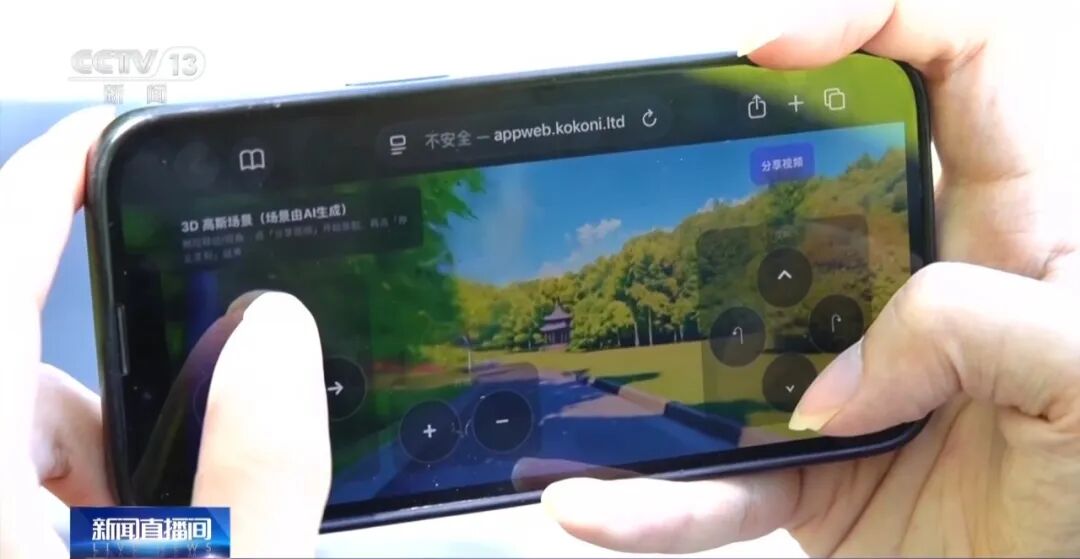
“World models are more like giving machines a brain for understanding the world, so they can understand the environment they are in,” Chen said. On camera, he demonstrated a mobile application of the model: with just one photo, the model can imagine and generate a 3D environment very close to the real surroundings at the moment the photo was taken. After taking the photo, users can choose different styles and even move forward or backward within the environment. “Even for the space behind it, it can infer that the path continues and that you can keep moving further back,” Chen said, fully demonstrating the model’s scene understanding and prediction capabilities.
Chen Tianrun, founder of Moxin Technology, earned his bachelor’s degree from Zhejiang University’s College of Information and Electronic Engineering and was later admitted to the College of Computer Science for a PhD through the university’s recommendation program. His training at ZJU laid a solid foundation for his path in science and innovation.
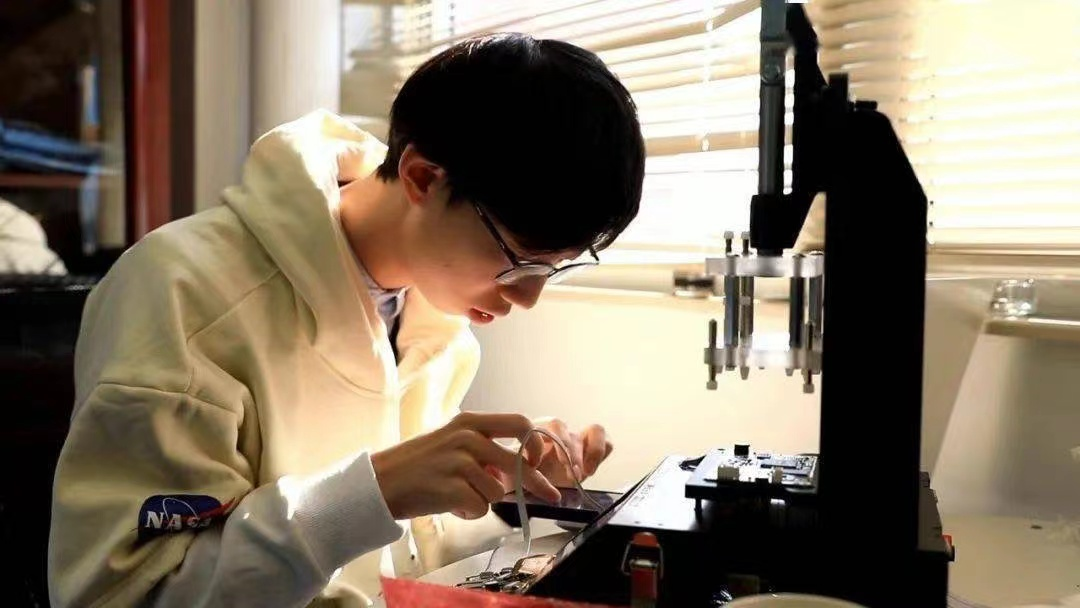
Early in his studies, he and his roommates tried to turn everyday inspiration into inventions such as a semi-autonomous self-balancing scooter and a robotic arm that can solve a Rubik’s Cube. One of their projects, “Goprint—Pioneer of Smart Printers,” placed third in the 7th China International “Internet+” College Students Innovation and Entrepreneurship Competition.
Thanks to the free and open innovation and entrepreneurship culture on campus, he co-founded Moxin Technology in June 2021 with other ZJU alumni. Beyond campus, Chen and his team have stayed true to their original aspirations, continued to strengthen their talent pool, and achieved technological leaps. In the early days, the team focused on AI-driven 3D content generation, building products and pursuing commercialization while gradually accumulating a wealth of 3D data assets and engineering experience. In 2024–2025, the team made progress in world model R&D, giving the company an opportunity to compete with the world’s leading teams in the field.
“This is an adventure, but behind the adventure is the fact that we are truly at the helm, steering this ship. So I believe that since the helm is in our hands, we hope to sail this ship very far.” From a ZJU student to a pioneering entrepreneur, Chen Tianrun and the Moxin Technology team’s journey in pursuit of their dreams is a story of keeping their feet on the ground while reaching for the stars. Today, the company has achieved substantive breakthroughs in both world model technology R&D and commercialization. It has brought together dozens of leading market-oriented funds and industrial investors through multiple rounds of financing, and is about to officially begin its capital market process, advancing toward higher-level industrial development goals.
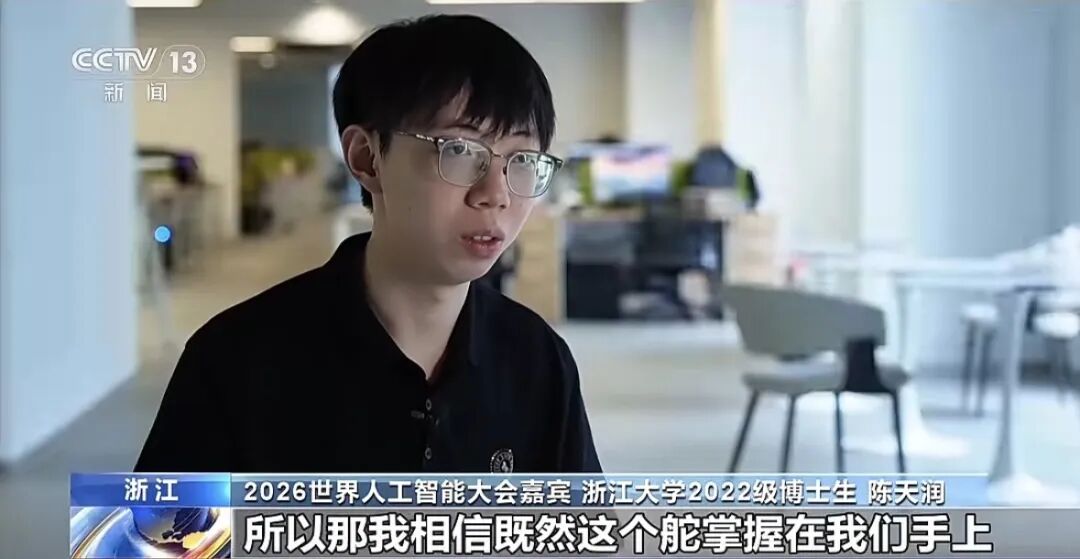
Chen Tianrun’s growth reflects the relentless pursuit of excellence that defines students at the College of Computer Science. Zhejiang University’s educational ecosystem and culture of technological innovation have given him the courage to dream and experiment, to actively pursue innovation and independent R&D, to keep inclusivity at heart, and to think with a global perspective. This pure pursuit, free from utilitarian concerns, is precisely the unique strength that the university’s “Seeking Truth and Pursuing Innovation” motto gives to young people.
Starting from a small creative idea in a dorm room, Chen Tianrun continues to move forward with the innovative confidence bestowed by the Qiushi campus. Generation after generation of ZJU students are following the same path to the frontier, using the power of youth to take part, hands-on, in every pioneering effort of scientific and technological exploration.