Recently, the IEEE Computer Society announced the results of its 2025 Best Paper Awards. This year, IEEE Transactions on Visualization and Computer Graphics (TVCG)—a CCF-A ranked top international journal—established the award for the first time. Of only three winning papers, two came from the College of Computer Science’s CAD&CG State Key Laboratory, earning Best Paper Awards in both computer graphics and visualization/visual analytics and sweeping all of this year’s awards from China and the Asia-Pacific region. Notably, TVCG published more than 800 papers in 2025, making the award rate less than 0.4%.
Professor Zhang Guofeng’s team won the Best Paper Award in Computer Graphics for “PGSR: Planar-based Gaussian Splatting for Efficient and High-Fidelity Surface Reconstruction.”
Professor Wu Yingcai’s team won the Best Paper Award in Visualization and Visual Analytics for “ChartGPT: Leveraging LLMs to Generate Charts From Abstract Natural Language.”
Warm congratulations to the winning teams!
Award-Winning Papers
Professor Zhang Guofeng’s team won the Best Paper Award in Computer Graphics for “PGSR: Planar-based Gaussian Splatting for Efficient and High-Fidelity Surface Reconstruction.”
Paper Title: PGSR: Planar-based Gaussian Splatting for Efficient and High-Fidelity Surface Reconstruction
Authors: Danpeng Chen¹,², Hai Li⁵, Weicai Ye¹,³, Yifan Wang³, Weijian Xie¹,⁴, Shangjin Zhai⁴, Nan Wang⁴, Haomin Liu⁴, Hujun Bao¹, Guofeng Zhang¹
Affiliations: ¹Zhejiang University, ²Tetras.AI, ³Shanghai AI Laboratory, ⁴SenseTime Research, ⁵RayNeo
Overview: In recent years, 3D Gaussian Splatting has attracted widespread attention for its high-quality rendering and extremely fast training and rendering speeds. However, Gaussian point clouds are unordered and irregular. Relying solely on image reconstruction loss makes it difficult to ensure geometric reconstruction accuracy and multi-view consistency, causing surface models extracted by existing methods to suffer from noise, holes, and missing details. To address this, this paper proposes PGSR, a fast surface reconstruction method based on planar Gaussian splatting that achieves high-fidelity 3D surface reconstruction while maintaining high-quality real-time rendering.
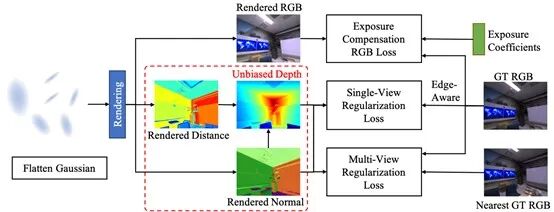
PGSR Method Overview
The core innovation of PGSR lies in compressing 3D Gaussians into planar representations well suited to describing real object surfaces, along with an unbiased depth rendering method. The method first renders the distance from each Gaussian plane to the camera origin and its normal vector, then computes depth consistent with the actual surface from the two, effectively reducing bias and noise in conventional Gaussian depth estimation. On this basis, the paper further introduces single-view geometric constraints and multi-view photometric and geometric consistency constraints to improve global consistency and local detail. It also designs a camera exposure compensation model to handle complex scenes with large lighting and exposure variations across viewpoints. Experimental results show that PGSR achieves leading geometric reconstruction accuracy on indoor and outdoor datasets such as Mip-NeRF 360, DTU, and Tanks and Temples, while retaining 3DGS’s high-quality rendering and high-speed performance. The method requires only about one hour of training on a single GPU—nearly 100× faster than representative NeRF surface reconstruction methods that require eight GPUs and two days—offering an efficient, high-fidelity 3D reconstruction solution for applications such as AR/VR, digital twins, 3D content generation, and autonomous driving.
Project Page: https://zju3dv.github.io/pgsr/
Code: https://github.com/zju3dv/PGSR
Professor Wu Yingcai’s team won the TVCG Best Paper Award in Visualization and Visual Analytics for “ChartGPT: Leveraging LLMs to Generate Charts From Abstract Natural Language.”
Paper Title: ChartGPT: Leveraging LLMs to Generate Charts From Abstract Natural Language
Authors: Yuan Tian¹, Weiwei Cui², Dazhen Deng¹, Xinjing Yi¹, Yurun Yang¹, Haidong Zhang², Yingcai Wu¹
Affiliations: ¹Zhejiang University, ²Microsoft
Overview: In recent years, generating charts directly from natural language has become an important research direction in visualization. However, users’ natural language instructions are often ambiguous and lack explicit specifications for visual encoding. Previous methods rely largely on lexical parsing and predefined rules and are limited by the language understanding of parsers, making it difficult to handle such ambiguous input and limiting their practical use. To address this challenge, this paper proposes ChartGPT, a large model for chart generation from ambiguous natural language instructions.
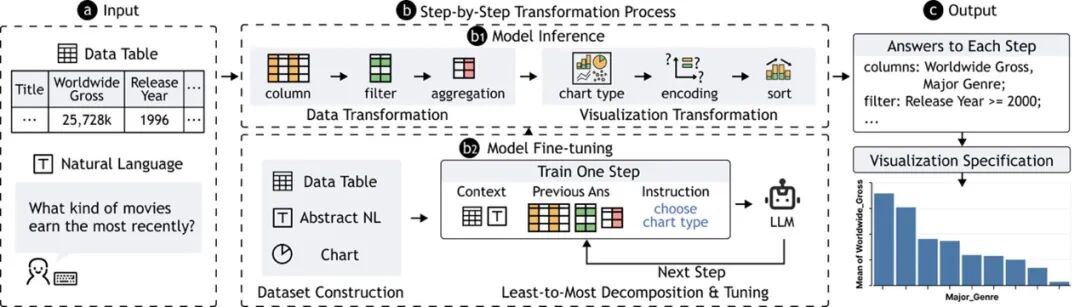
ChartGPT Method Overview
The core innovation of ChartGPT is decomposing the complex chart generation task into two stages—data transformation and visualization transformation—and six interpretable reasoning subtasks. This enables the large language model to progressively make key decisions such as data attribute selection, data aggregation, chart type selection, and visual encoding mapping, improving the accuracy and controllability of the generation process. To address the lack of visualization domain knowledge in general-purpose LLMs, the paper further constructs a dataset of ambiguous natural language instruction–chart pairs and fine-tunes the model to enhance its chart generation capabilities. The system also features a human-in-the-loop interactive interface that allows users to inspect and modify intermediate reasoning results and iteratively refine the final chart. Experimental results show that ChartGPT outperforms existing methods in quantitative evaluation, and a user study confirms its effectiveness and practical value for natural-language visualization generation.
Project Page: https://huggingface.co/ZJUIDG/chartgpt-llama3