More than 1 billion people worldwide suffer from psychiatric disorders such as depression, and about 30% respond poorly to medication, creating an urgent need for new treatment strategies. Invasive brain–computer interfaces (BCIs) offer a new path for treatment-resistant psychiatric disorders: intracranial electrodes record neural activity, decode disease-related brain states in real time, and use those decoded states as feedback signals to dynamically adjust stimulation parameters, forming a closed-loop treatment process. One core feature of affective disorders such as depression is abnormal emotional states. Therefore, the first problem a clinically viable BCI treatment system must solve is how to read out a patient’s emotional state with precision, stability, and real-time speed.
On July 22, 2026, the team led by Research Professor Yang Yuxiao and Professor Wang Yueming at the State Key Laboratory of Brain-Machine Intelligence, Zhejiang University, together with Chief Physician Zhu Junming’s team and Chief Physician Hu Shaohua’s team, published a research paper titled “Cross-task, explainable and real-time decoding of human emotion states by integrating gray and white matter intracranial neural activity” in Nature Computational Science. The study built a large-scale, high-quality dataset of intracranial neural signals representing human emotion, developed an invasive BCI method and system, and achieved fine-grained, cross-task, explainable, online dynamic decoding of human emotions. Its fine-grained regression decoding of emotional valence and arousal doubled the performance of existing EEG-based emotion decoding studies, providing a technical foundation for invasive BCI treatment of psychiatric disorders.

Research Background
How can invasive BCIs be used to treat psychiatric disorders? Deep brain stimulation is already relatively mature for neurological disorders such as Parkinson’s disease and epilepsy, but neuromodulation for psychiatric disorders such as depression still faces challenges, including complex symptom fluctuations, unclear neural biomarkers, and an incomplete understanding of how stimulation works. Invasive BCI treatment of psychiatric disorders remains exploratory, and current technical approaches fall broadly into two categories. One borrows from responsive stimulation strategies used in Parkinson’s disease and epilepsy, triggering stimulation when abnormal neural activity is detected. The other targets more complex brain states through control-theoretic dynamic modulation, treating emotional states as continuously changing dynamical systems and adaptively computing the required stimulation parameters based on real-time neural feedback. Whichever approach is used, BCI treatment depends on reliable neural decoding—the ability to stably decode emotion-related states from brain activity and convert them into control signals for feedback modulation.
What kind of emotion decoding does an invasive BCI need? A clinically viable emotion decoding model must meet at least four conditions. First, it must deliver high performance. Emotion-related neural activity is widely distributed, so decoding must move beyond the traditional use of gray matter signals alone and tap the value of white matter signals for improving performance. Second, it must generalize across scenarios by capturing shared brain states across different induction methods. Third, it must be interpretable, clearly identifying the spatial, temporal, and frequency-domain information in brain signals that supports decoding. Fourth, it must run online in real time to support applications such as closed-loop modulation. With these goals in mind, the team built an integrated experimental and computational framework spanning offline modeling and online validation.
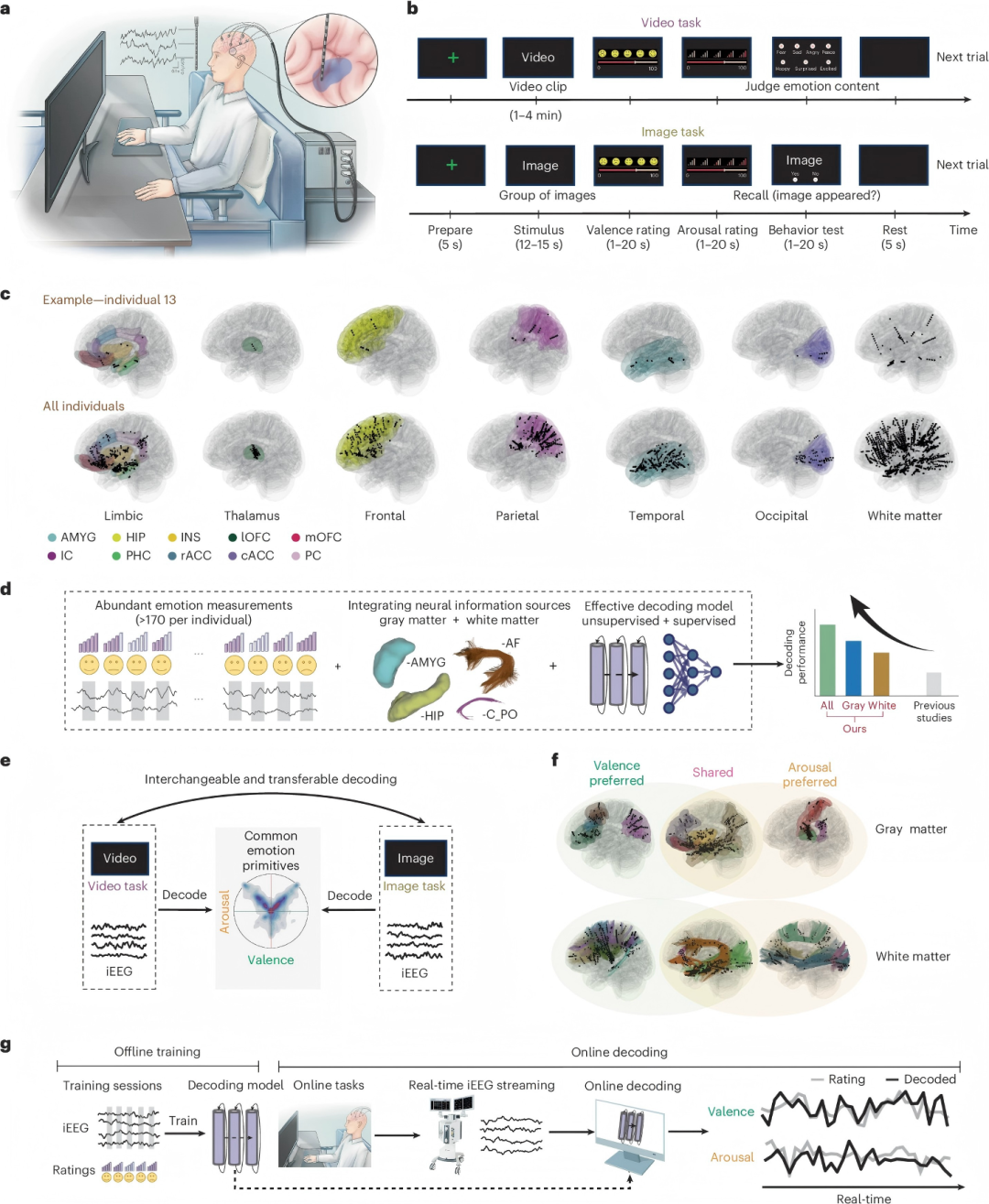
Figure 1. Invasive BCI enables fine-grained, cross-task, explainable, and online dynamic decoding of human emotions
Methods
The study included 22 subjects with drug-resistant epilepsy who had SEEG electrodes implanted for clinical diagnosis and treatment. Data from 18 subjects were used for offline decoding analysis, and 4 subjects participated in online real-time decoding. Subjects watched images and videos in emotion induction tasks and self-rated their valence and arousal after each trial. Intracranial EEG was recorded simultaneously, with electrodes broadly covering the limbic system, cortex, subcortical structures, and white matter tracts. This produced a large, high-quality intracranial emotion decoding dataset containing about 90 hours of intracranial EEG recordings and 3,000 emotion labels.
Each subject then had a personalized decoding model trained. The model first extracted spectral power features, then used feature selection, a self-supervised LSTM autoencoder, and a supervised multilayer perceptron module to map high-dimensional neural dynamics onto continuous valence and arousal scores. Performance was mainly evaluated using the trial-independent cross-validated correlation coefficient (cvCC) and the cross-validated coefficient of determination (R²).
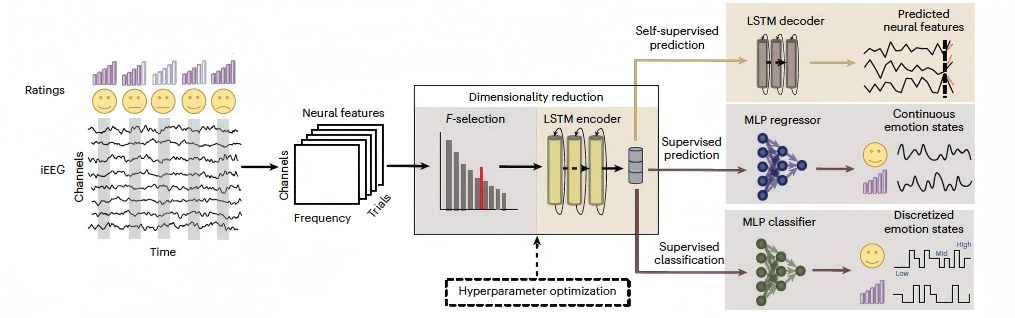
Figure 2. Personalized deep-learning model for emotion decoding.
Key Results
1. Gray–white matter signal fusion significantly improves emotion decoding performance
The personalized models significantly decoded continuous valence and arousal ratings. In the video task, group-level valence decoding reached a cross-validated cvCC of 0.70 and an R² of 0.49, more than doubling the average performance of existing EEG and SEEG emotion decoding models (R² = 0.21). The model also showed significant decoding ability in the picture task. The team further found that signals recorded from white matter are not merely noise, as traditionally assumed. When decoded alone, white matter signals performed slightly worse than gray matter signals but still significantly above chance. When gray and white matter signals were fed into the model together, decoding performance was significantly better than with either signal type alone, indicating that white matter signals provide complementary information.
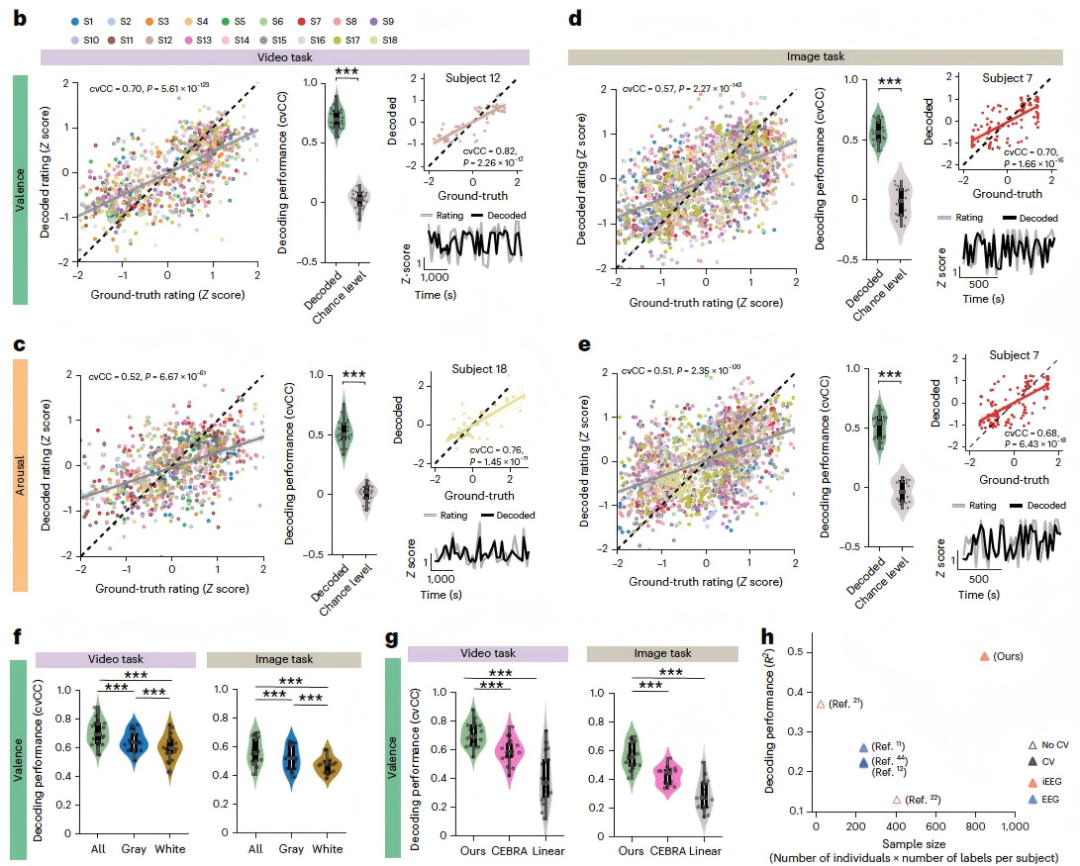
Figure 3. High-performance decoding
2. The model identifies transferable neural representations of emotion
The team then tested whether a model trained on one task could transfer to another. Cross-task models performed worse than models trained directly on the target task, but significantly better than chance. More importantly for applications, a cross-task model could serve as a pretrained model and be rapidly fine-tuned with a small amount of target-task data. With only 50% of trials (about 43), its performance approached that of a model trained within the target task. These results suggest that the model can identify transferable neural representations related to emotion dimensions.
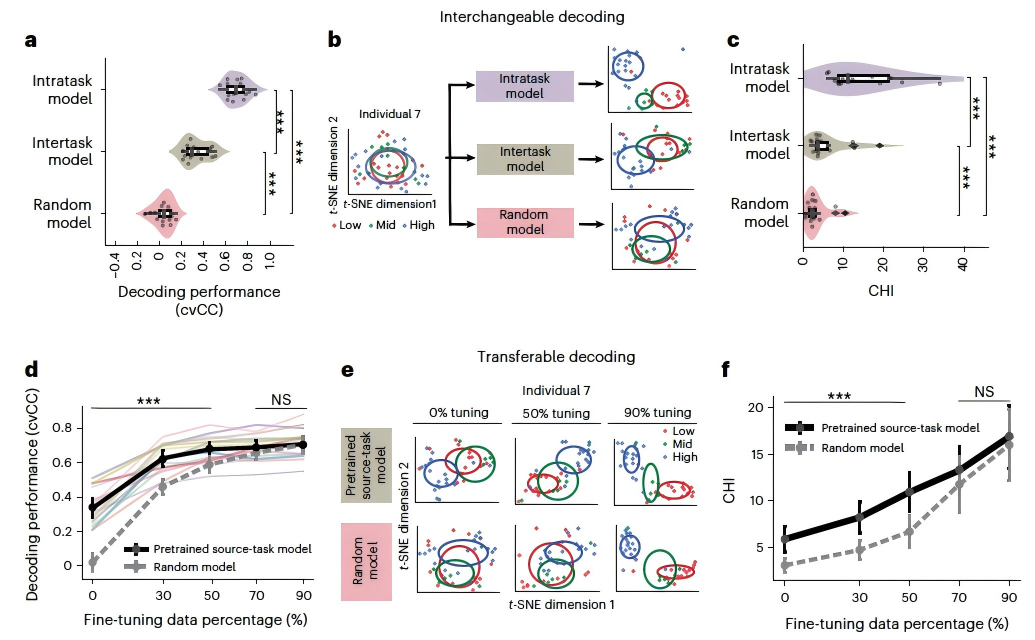
Figure 4. Cross-task decoding
3. The model reveals shared and biased encoding of emotion dimensions in the limbic–thalamic–cortical network
To make the decoding model not only predictive but also explanatory, the team analyzed which brain regions and white matter tracts were most critical. About four key brain regions were enough to approach whole-brain performance, suggesting that a small set of key regions can support high-performance emotion decoding. These key regions fell into three categories: shared encoding of valence and arousal was mainly located in limbic–cortical areas; valence encoding was more biased toward the posterior lateral frontoparietal pathway; and arousal encoding was more biased toward the thalamus and other regions. White matter tracts showed a similar shared/biased distribution.
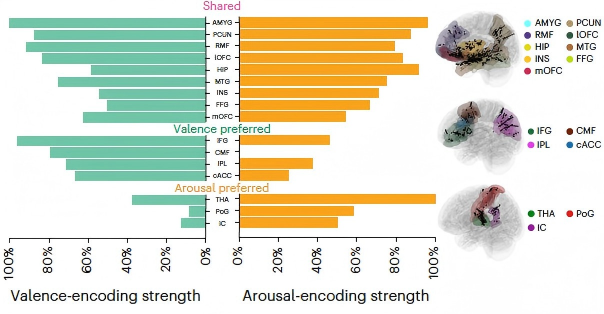
Figure 5. Shared and biased encoding of emotion dimensions
4. From offline analysis to an online system: real-time emotion decoding
Online real-time validation is a key step toward applying emotion decoding. The team built an online BCI system: personalized models were trained through offline experiments on the first day; on the next day, the system was connected to real-time intracranial EEG data streams and output decoding results online during an online task. All four subjects’ online decoding performance was significantly above chance and comparable to offline training performance, with an average system latency of 376 ms.
Conclusions and Outlook
This study proposed a high-performance, cross-task, explainable, and real-time intracranial EEG decoding framework for human emotional states. Key innovations include: first, high-performance decoding through gray–white matter signal fusion; second, identification of transferable neural representations across different induction tasks; third, discovery of shared and biased encoding of emotion in the limbic–thalamic–cortical network; and fourth, online real-time validation. Overall, the study provides a new computational framework for neural decoding of human emotional states, moving emotion decoding from offline analysis toward online systems and providing an important technical foundation for invasive BCI treatment of psychiatric disorders.
Yang Yuxiao, Research Professor at the State Key Laboratory of Brain-Machine Intelligence and the Second Affiliated Hospital, Zhejiang University School of Medicine, is the first author and co-corresponding author. Chen Wenjun, a PhD student at the College of Computer Science and Technology, is a co-first author. Professor Wang Yueming of the State Key Laboratory of Brain-Machine Intelligence and the College of Computer Science and Technology, Chief Physician Zhu Junming of the Second Affiliated Hospital, and Chief Physician Hu Shaohua of the First Affiliated Hospital are co-corresponding authors. Graduate student Chen Yuyang; Ding Ling; Zhang Chi; physicians Wang Shuang, Jiang Hongjie, Zhu Zhoule, and Guo Xinxia; Professor Pan Gang; and Physician Wei Ning also made important contributions. This research was supported by the National Natural Science Foundation of China, the Zhejiang Provincial “Jianbing” (Pioneer) Program, the Zhejiang Provincial Natural Science Foundation, and other projects.
Original article link:
https://www.nature.com/articles/s43588-026-01021-w