Imagine moving a cursor freely across a screen without lifting a finger—simply by imagining movements of your left hand, right hand, tongue, or feet. That is the intelligent interaction promised by motor imagery brain-computer interfaces (MI-BCIs). Yet a real-world dilemma persists: deep learning’s impressive offline performance often falls short in actual online interaction. Users must constantly adjust their brain activity based on feedback, and rapidly shifting brain signals leave many algorithms struggling. Can deep learning actually make brain control genuinely usable? This question has long lacked rigorous experimental validation.
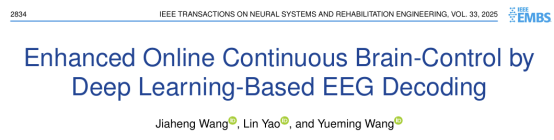
Recently, a team led by Research Professor Yao Lin and Professor Wang Yueming provided a strong answer. Their paper in IEEE TNSRE, “Enhanced Online Continuous Brain-Control by Deep Learning-Based EEG Decoding,” proposes the deep learning decoding model IFNet and, for the first time, uses randomized, cross-session online cursor-control experiments to move beyond comparisons of online decoding algorithms alone. The results show that for first-time BCI users, IFNet improved online performance by 20% and 27% in two cross-day experiments—solid evidence that deep learning is not just impressive on paper, but can significantly improve control in real closed-loop interaction. The work received the IEEE TNSRE 2025 Best Paper Award, one of only four papers honored that year, helping advance the usability of motor imagery BCIs.
Research Background and Core Question
For years, online MI-BCIs have relied mainly on traditional machine learning methods such as FBCSP. In recent years, deep learning models have continually set new decoding accuracy records in offline analyses of public EEG datasets. But online brain control involves a dynamic human-machine interaction system:
Online tasks and offline calibration scenarios may differ.
EEG signals vary across contexts and days.
Users actively adjust their motor imagery strategies based on decoded feedback.
Fatigue, device fluctuations, and other factors can all affect model robustness.
The field therefore urgently needs to answer this question: When a deep learning model enters a real-time BCI feedback system and continuously interacts with a user, can it deliver a more accurate, stable, and learnable brain-control experience than traditional, neurophysiologically interpretable machine learning algorithms?
Study Design
The study recruited 15 BCI-naive participants, each of whom completed two cross-day sessions. Each experiment included an offline calibration stage and an online feedback stage. In the online feedback stage, participants performed a 2D center-out task using motor imagery alone, controlling a cursor from the center of the screen to randomly appearing targets around it. The decoding algorithms were alternated using block randomization.
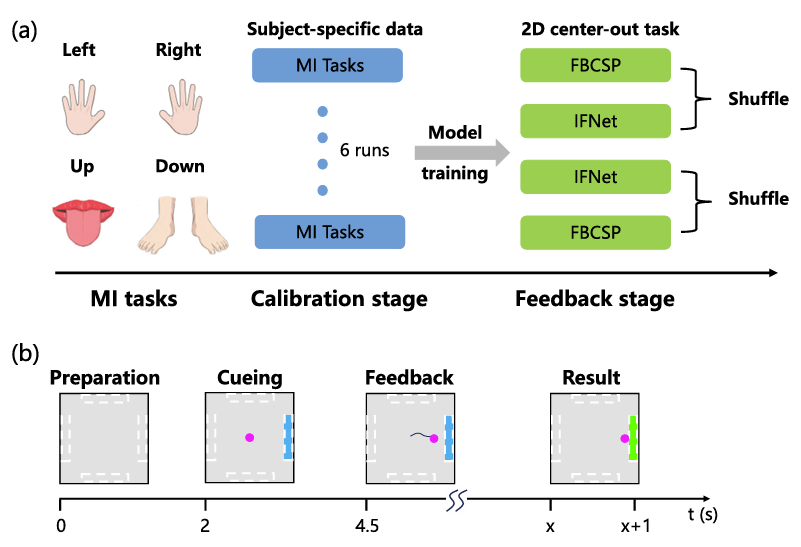
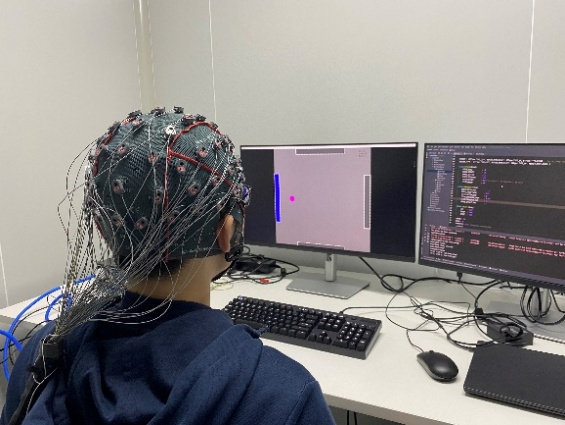
Figure 1. Experimental pipeline and setup
The study mainly compared the lightweight deep learning model IFNet (Interactive Frequency CNN) with the traditional mainstream machine learning algorithm FBCSP. IFNet is based on cross-frequency coupling in EEG signals and explicitly models interactions between low- and high-frequency EEG features. It jointly extracts task-related EEG information across the frequency, spatial, and temporal domains, effectively enhancing motor EEG representations.
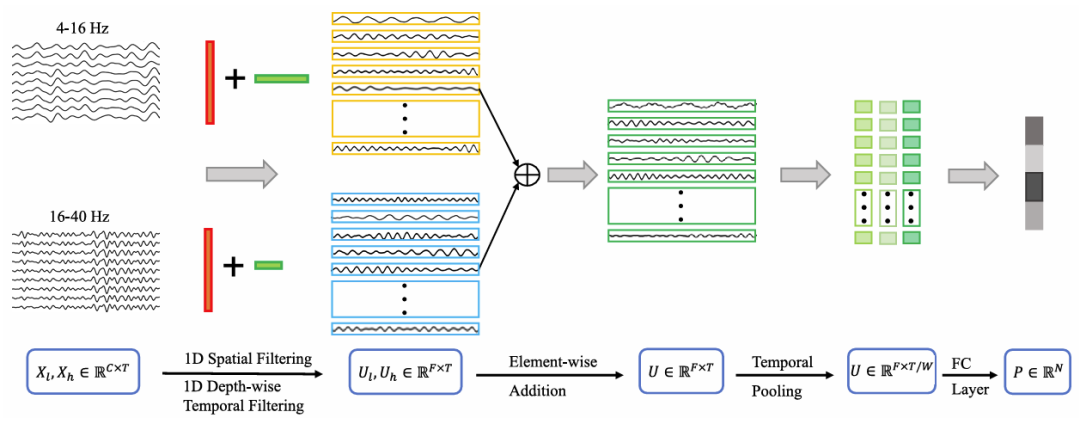
Figure 2. IFNet EEG decoding model
Findings
01. The deep learning model significantly improves online brain-control performance
In the 2D center-out task, IFNet achieved average task accuracies of 51.58% and 65.58% in the two sessions, improvements of 20% and 27% over FBCSP, respectively. Other metrics further showed that IFNet delivered better path efficiency and information transfer rate.
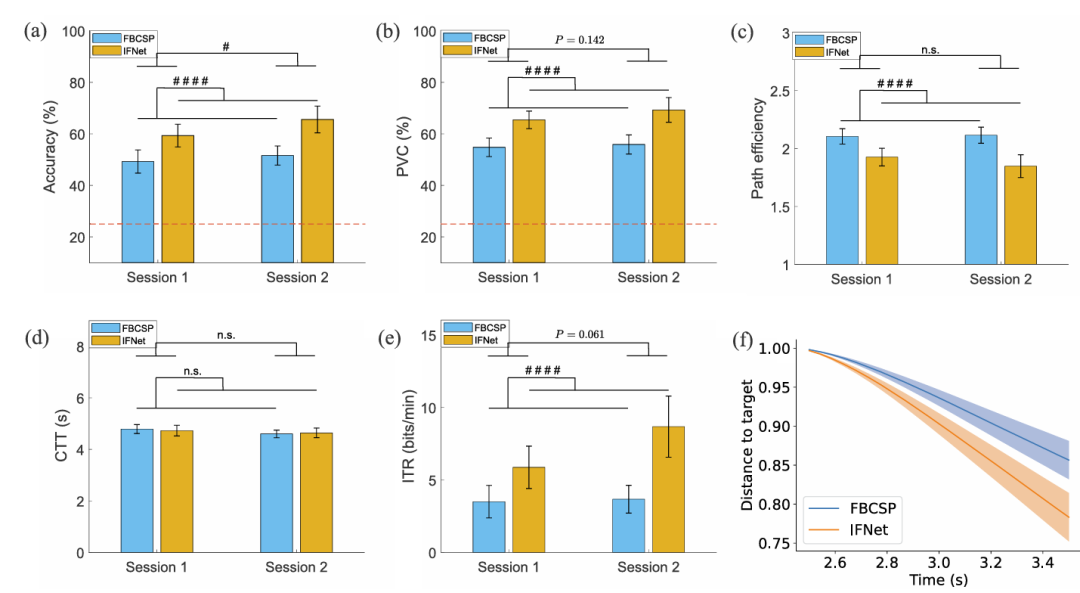
Figure 3. Online motor brain-control performance
02. The deep learning model shows a significant BCI training effect
Cross-session results showed that with IFNet, participants exhibited a significant BCI training effect (P = 0.017), whereas FBCSP did not reach significance (P = 0.337). In subjective ratings, the control experience with IFNet was significantly better than with FBCSP and improved further as the sessions progressed. This suggests that deep learning can not only improve EEG decoding accuracy but also help users acquire BCI skills more smoothly.
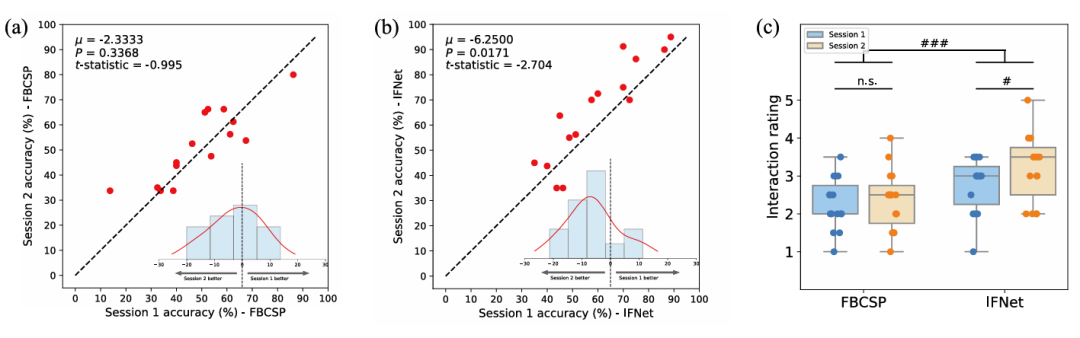
Figure 4. Cross-session BCI training effect
03. Offline validation and neurophysiological interpretability
The team further compared IFNet offline with deep learning models including EEGNet, FBCNet, EEG Conformer, and TSFCNet. Deep learning models generally outperformed FBCSP, with IFNet maintaining the highest average accuracy across tests. Notably, in this study’s 2D center-out task, offline evaluation closely matched real online performance, offering a useful reference for future offline assessment of online decoding performance.
R² brain topography showed that the most neurophysiologically discriminative information was concentrated near electrodes C3 and C4 in motor-related brain regions. Attribution analysis indicated that IFNet effectively captured motor imagery–specific EEG representations. The two sets of results were consistent.
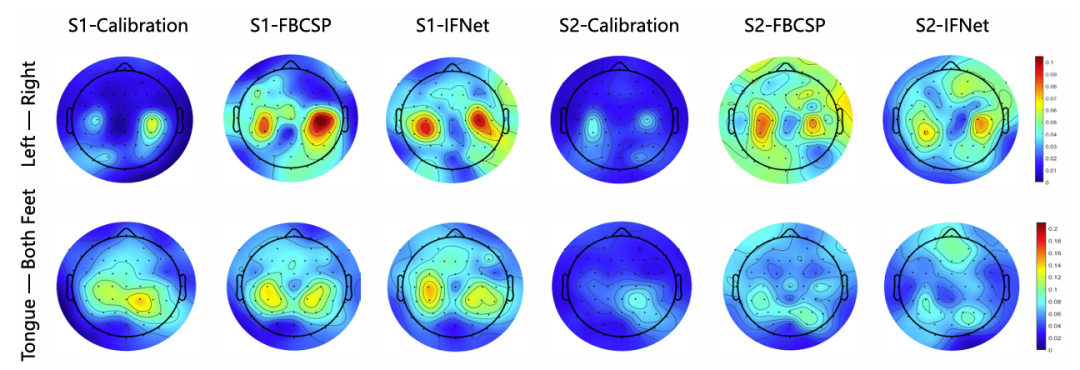
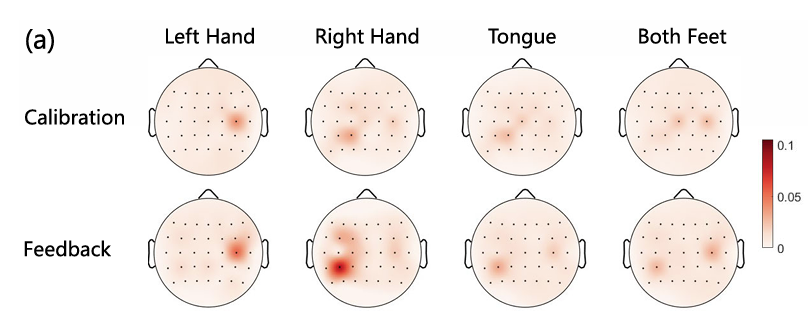
Figure 5. Neurophysiological interpretability
Summary and Outlook
The key significance of this study is that it moves deep learning–based EEG decoding from offline comparisons on standard datasets into real-time feedback, multi-session online motor brain-control systems.
It provides the first demonstration that a well-designed lightweight deep learning model can deliver a perceptible performance jump when users first use a BCI, while also enabling faster adaptation and smoother control during subsequent training.
This not only provides key technical support for building more efficient and user-friendly non-invasive motor BCIs, but also makes clinical applications such as EEG-based post-stroke motor rehabilitation practically poised to move from “feasible” to genuinely “usable.”
The first author is Wang Jiaheng, a PhD student at the State Key Laboratory of Brain-Machine Intelligence and the College of Computer Science and Technology, Zhejiang University. The corresponding author is Research Professor Yao Lin of the State Key Laboratory of Brain-Machine Intelligence and the MOE Frontier Science Center for Brain Science and Brain-Machine Integration. The research was jointly supervised by Professor Wang Yueming and Research Professor Yao Lin.
This research was supported by the STI 2030—Major Projects “Brain Science and Brain-Like Intelligence,” the National Natural Science Foundation of China, and other projects.
Original article:
https://doi.org/10.1109/TNSRE.2025.3591254
Code repository:
https://github.com/Jiaheng-Wang/MI-BCI