In Brief
The brain continuously produces rich neural signals that encode a person’s thoughts, emotions, and cognitive states. To enable machines to truly understand these signals and grasp the essence of brain activity, the foundation model paradigm offers a new, large-scale data-driven path: learning the underlying patterns and structures from data to form an understanding of its intrinsic nature, rather than stopping at surface-level fitting. EEG foundation models bring this idea to neural signals, using self-supervised pretraining on massive unlabeled EEG data to uncover the intrinsic semantic content of brain signals—the common underlying principles that span different brain activities—thereby enabling general interpretation of the latent information in the brain.
A team led by Research Professor Zhao Sha and Professor Pan Gang at the State Key Laboratory of Brain-Machine Intelligence, Zhejiang University, has pursued the goal of general interpretation of latent brain information. Through multiple rounds of iterative optimization, the team has explored three key areas—architecture design, pretraining, and task adaptation—while integrating neurophysiological priors, achieving several important advances in EEG foundation models that have drawn widespread attention from peers at home and abroad. Their models have reached over 18,000 monthly downloads on Hugging Face at peak.
01 Research Background
Extracting Semantic Information from Complex Brain Signals
EEG is the most commonly used non-invasive signal in brain-computer interfaces. It spans a wide range of scenarios, including motor imagery, emotion recognition, sleep staging, epilepsy detection, and psychiatric diagnosis, making it an important window into brain activity. However, the “semantics” of EEG signals are not explicitly readable like text. They are implicit in complex spatiotemporal structures and neurophysiological properties, making them difficult to parse directly. For a long time, representations learned by EEG decoding models have remained at the level of surface statistical mappings of signals, struggling to consolidate into a unified understanding of brain activity.
The foundation model paradigm offers new possibilities for breaking through this limitation and moving toward general intelligence for brain signal interpretation: self-supervised pretraining driven by large-scale unlabeled EEG data allows models to learn general representations transferable across tasks and scenarios, potentially breaking down task barriers and reaching the intrinsic semantic content of brain signals.
Unlike text, the patterns of EEG signals are deeply rooted in spatiotemporal structures and neurophysiological properties. Relying solely on generic sequence modeling and scaling often leaves models at surface statistical patterns, unable to truly understand the intrinsic principles of brain activity. Therefore, how can foundation models go beyond data-driven learning to align with the neurophysiological structure of brain signals, learning general representations that reflect the essence of brain activity rather than remaining at task-level fitting? This is a core question that must be answered on the path toward general brain semantic decoding.
02 Research Progress
Building an EEG foundation model can be broken down into three core components:
Architecture determines how the model encodes EEG signals;
Pretraining determines how the model learns general representations from unlabeled data;
Task adaptation determines how the pretrained model continues to serve diverse downstream tasks.
The team explored these three components progressively, with neurophysiological priors as a unifying thread, gradually forming a new approach to EEG foundation models guided by brain mechanisms.
Network Architectures Based on EEG Spatiotemporal Properties
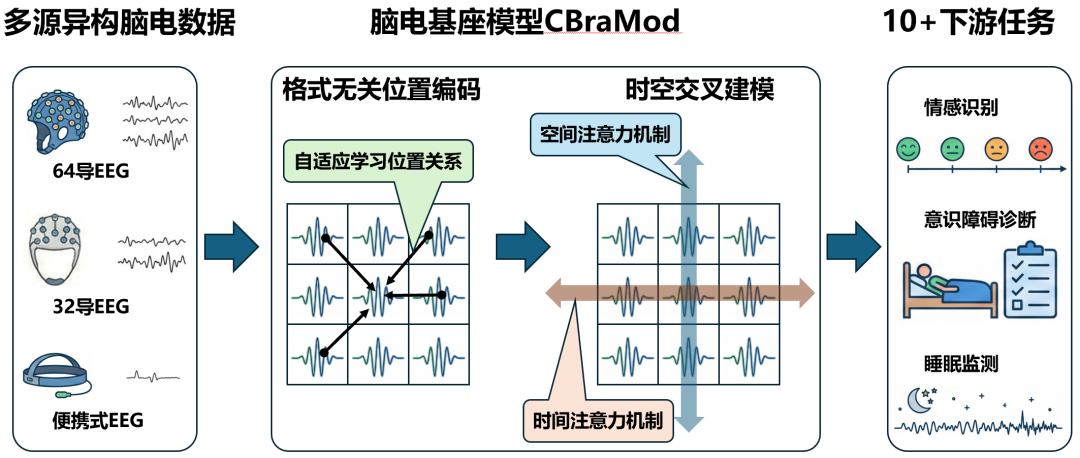
The team uses sequence modeling models such as Transformer and Mamba as the core backbone of EEG foundation models—these models can model dependencies between arbitrary signal segments, matching the brain’s property of widespread interaction across regions. On this basis, the team made three innovations:
First, they transformed the Transformer’s self-attention into “cross-attention,” using parallel spatial attention and temporal attention to characterize cross-channel dependencies at the same moment and cross-time dependencies within the same channel, respectively. They also designed asymmetric conditional position encoding (ACPE) to dynamically adapt to diverse electrode arrangements, making the backbone fit the spatiotemporal structure of EEG.
Second, they explored more efficient backbones, extending the Mamba state space model into bidirectional encoding with alternating forward and backward stacks to capture bidirectional dependencies with linear complexity, and allowing free replacement with Transformer under a unified framework.
Third, they injected neurophysiological priors into the backbone input. In the spatial dimension, based on the principle of volume conduction, they constructed channel position encoding using 3D electrode coordinates and learnable spatial decay kernels. In the temporal dimension, they designed slow oscillation bases and adaptive decay bases to characterize second-scale slow modulation and neural adaptation, forming multi-scale complementarity with the millisecond-scale fast oscillations captured by the backbone. The backbone remains general, while the spatiotemporal properties and neural mechanisms of EEG are internalized into the model’s inductive biases through attention design and position encoding.
Pretraining Based on Neural Statistics Prediction
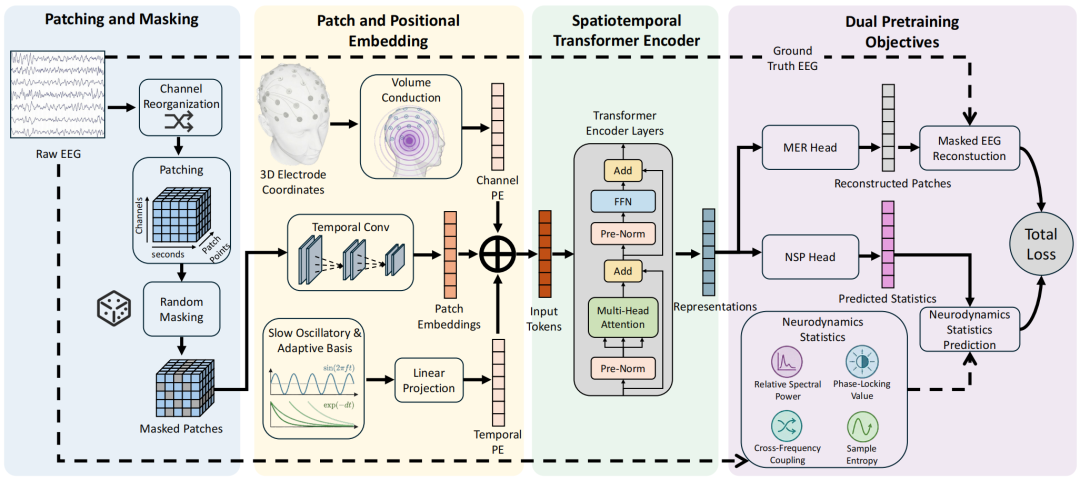
The pretraining objective determines what knowledge the model learns from unlabeled EEG. The team adopted masked EEG reconstruction as a self-supervised objective, masking portions of signal segments and requiring the model to reconstruct them. This objective, inherited from generic sequence modeling, can capture surface statistical patterns of signals.
In addition, the team observed in experiments that under a “frozen backbone, train classification head only” probing setup, model performance dropped significantly, indicating that the learned representations still leaned toward task-related statistical patterns and had not yet reached general neural principles. To address this, the team introduced neural dynamics statistics prediction alongside the reconstruction objective, requiring the model to predict macroscopic order parameters such as spectral power, phase locking value, cross-frequency coupling, and sample entropy. This pushes the learning signal from signal reconstruction toward neural dynamics modeling.
Experiments show that this method performs excellently in end-to-end fine-tuning and significantly outperforms existing methods under a “frozen backbone + task probe” protocol, indicating that its representations have stronger intrinsic generality and transferability.
Continual Adaptation for Heterogeneous Tasks
Architecture and pretraining lay the foundation for general representations, while task adaptation determines whether the model can efficiently and continuously serve diverse downstream tasks. If each new task requires isolated fine-tuning and saving a separate set of parameters, the model remains difficult to scale.
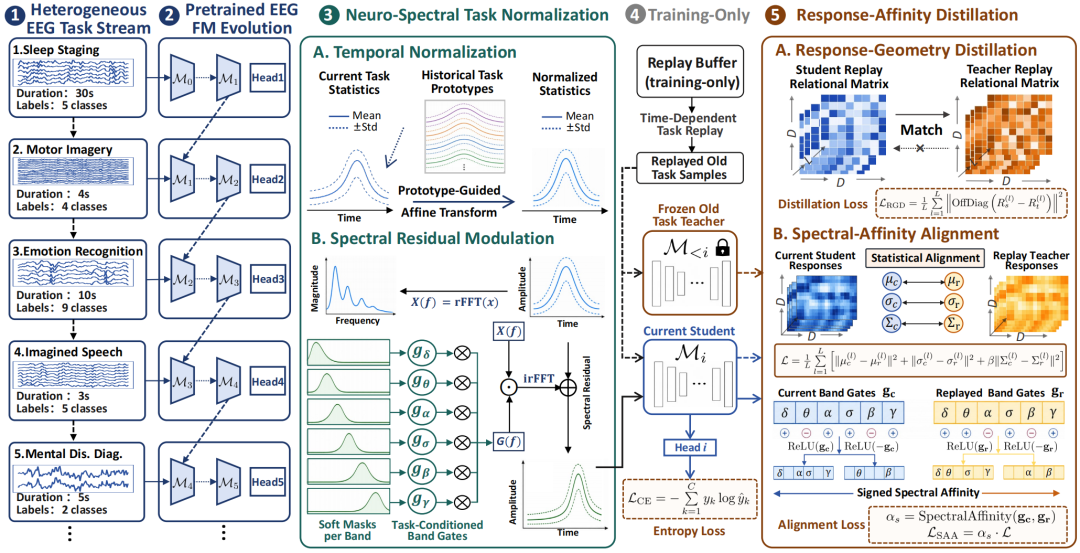
The team formalized this problem as “cross-task continual learning” and proposed a continual learning framework that enables a single EEG foundation model to learn multiple heterogeneous tasks sequentially without forgetting old capabilities.
The framework includes two core mechanisms:
Neural spectral task normalization aligns inputs over time using statistical prototypes from historical tasks, and dynamically adjusts specific frequency band responses via task-conditioned band gating, mitigating distribution drift across tasks;
Response affinity distillation preserves the response geometry of old tasks while replaying old task samples, and selectively transfers knowledge based on spectral affinity to avoid negative transfer.
In continual learning experiments across six tasks, including motor imagery and emotion recognition, the method is compatible with multiple mainstream backbones such as Transformer and Mamba, and outperforms existing methods in all cases.
03 Summary and Outlook
Through progressive exploration of architecture, pretraining, and task adaptation, with neurophysiological priors woven throughout the foundation model construction process, the team has formed an integrated technical pipeline for EEG foundation models:
At the architecture level, evolving from generic spatiotemporal modeling to neuro-mechanism-guided modeling;
At the pretraining level, evolving from signal reconstruction to neural-dynamics-guided representation learning;
At the task adaptation level, achieving continual learning across heterogeneous tasks.
These studies provide useful ideas for EEG signal analysis, self-supervised pretraining, and related fields, and offer technical support for application scenarios such as motor rehabilitation, emotion monitoring, and psychiatric diagnosis, opening new possibilities for the further development of brain-machine intelligence in healthcare and brain science.
Although EEG foundation models have made progress, there is still a gap to large-scale application. Future breakthroughs require coordinated progress on three fronts:
At the data infrastructure level, building large-scale, multi-paradigm, cross-device pretraining databases and standardized evaluation benchmarks;
At the neuroscience mechanism level, using priors such as neural dynamics to guide model design, and using model representations to reveal the implicit physiological structure of EEG signals in return, achieving bidirectional empowerment;
At the multimodal fusion level, exploring joint modeling of EEG with fNIRS, fMRI, eye tracking, EMG, and other signals, improving decoding robustness in complex scenarios through cross-modal alignment and complementarity.
Coordinated progress on these three fronts will be key to empowering the BCI industry with EEG foundation models.
Main contributors include Wang Jiquan, Zhao Sha, Zhou Yangxuan, Luo Zhiling, Jiang Haiteng, Li Tao, Li Shijian, Pan Gang, and others. This research was mainly supported by the STI 2030—Major Projects “Brain Science and Brain-Like Intelligence,” the National Natural Science Foundation of China, the Zhejiang Provincial Natural Science Foundation, and the Zhejiang Provincial “Jianbing” (Pioneer) Program.
04 Selected Lab Papers on EEG Foundation Models
CBraMod: A Criss-Cross Brain Foundation Model for EEG Decoding, ICLR 2025. (Ranked among the top in third-party peer evaluations)
https://openreview.net/forum?id=NPNUHgHF2w
Code: https://github.com/wjq-learning/CBraMod
EEGMamba: An EEG foundation model with Mamba, Neural Networks, 2025.
https://www.sciencedirect.com/science/article/pii/S0893608025006963
Code: https://github.com/wjq-learning/EEGMamba
DeeperBrain: A Neuro-Grounded EEG Foundation Model Towards Universal BCI, 2026.
https://arxiv.org/abs/2601.06134
EvoBrain: Continual Learning of EEG Foundation Models Across Heterogeneous BCI Tasks, 2026.
https://arxiv.org/abs/2606.01767
05 Selected Papers from Peers at Home and Abroad
Dingkun Liu, Yuheng Chen, Zhu Chen, Zhenyao Cui, Yaozhi Wen, Jiayu An, Jingwei Luo, Dongrui Wu. EEG-FM-Compass: Progress, Benchmarking, and Future Directions for EEG Foundation Models, National Science Review, 2026.
https://arxiv.org/abs/2601.17883
Ziling Lu, Zongsheng Li, Xinke Shen, Kexin Lou, Yingyue Xin, Xiaoqi Chen, Shinan Wang, Xiang Chen, Jiahao Fan, Chenyu Huang, Xin Xu, Zhoujie Hou, Chen Wei, Quanying Liu. OmniEEG-Bench: A Standardized Evaluation Benchmark for EEG Foundation Models, 2026.
https://arxiv.org/abs/2606.00815
Chaoqi Yang, M Westover, Jimeng Sun. BIOT: Biosignal Transformer for Cross-data Learning in the Wild, NeurIPS 2023.
https://arxiv.org/abs/2305.10351
Daoze Zhang, Zhizhang Yuan, Yang Yang, Junru Chen, Jingjing Wang, Yafeng Li. Brant: Foundation Model for Intracranial Neural Signal, NeurIPS 2023.
https://openreview.net/forum?id=DDkl9vaJyE
Zhizhang Yuan, Daoze Zhang, Junru Chen, Gefei Gu, Yang Yang. BrainWave: A Brain Signal Foundation Model for Clinical Applications, 2024.
https://arxiv.org/abs/2402.10251
Weibang Jiang, Liming Zhao, Baoliang Lu. Large Brain Model for Learning Generic Representations with Tremendous EEG Data in BCI, ICLR 2024.
https://openreview.net/forum?id=QzTpTRVtrP
Ziyi Li, Weilong Zheng, Jiwen Xu, Yong Lu, Baoliang Lu. Gram: A Large General EEG Model for Raw Data Classification and Restoration, IEEE Transactions on Affective Computing, 2025.
https://ieeexplore.ieee.org/abstract/document/11271181/
Wenhui Cui, Woojae Jeong, Philipp Thölke, Takfarinas Medani, Karim Jerbi, Anand A Joshi, Richard M Leahy. Neuro-GPT: Towards A Foundation Model for EEG, IEEE International Symposium on Biomedical Imaging, 2024.
https://arxiv.org/abs/2311.03764
Guagnyu Wang, Wenchao Liu, Yuhong He, Cong Xu, Lin Ma, Haifeng Li. EEGPT: Pretrained Transformer for Universal and Reliable Representation of EEG Signals, NeurIPS 2024.
https://openreview.net/forum?id=oNpINF5dIe
Qinfan Xiao, Ziyun Cui, Chi Zhang, Siqi Chen, Wen Wu, Andrew Thwaites, Alexandra Woolgar, Bowen Zhou, Chao Zhang. BrainOmni: A Brain Foundation Model for Unified EEG and MEG Signals, NeurIPS 2025.
https://arxiv.org/abs/2505.18185
Jingying Ma, Feng Wu, Qika Lin, Yucheng Xing, Chenyu Liu, Ziyu Jia, Mengling Feng. CodeBrain: Towards Decoupled Interpretability and Multi-Scale Architecture for EEG Foundation Model, ICLR 2026.
https://arxiv.org/abs/2506.09110
Yuchen Zhou, Jiamin Wu, Zichen Ren, Zhouheng Yao, Weiheng Lu, Kunyu Peng, Qihao Zheng, Chunfeng Song, Wanli Ouyang, Chao Gou. CSBrain: A Cross-scale Spatiotemporal Brain Foundation Model for EEG Decoding, NeurIPS 2025.
https://arxiv.org/abs/2506.23075
Zitao Fang, Chenxuan Li, Hongting Zhou, Shuyang Yu, Guodong Du, Ashwaq Qasem, Yang Lu, Jing Li, Junsong Zhang, Sim Kuan Goh. NeurIPT: Foundation Model for Neural Interfaces, NeurIPS 2025.
https://arxiv.org/abs/2510.16548
Yassine El Ouahidi, Jonathan Lys, Philipp Thölke, Nicolas Farrugia, Bastien Pasdeloup, Vincent Gripon, Karim Jerbi, Giulia Lioi. REVE: A Foundation Model for EEG Adapting to Any Setup with Large-Scale Pretraining on 25,000 Subjects, NeurIPS 2025.
https://arxiv.org/abs/2510.21585
Zhisheng Chen, Yingwei Zhang, Qizhen Lan, Tianyu Liu, Huacan Wang, Yi Ding, Ziyu Jia, Ronghao Chen, Kun Wang, Xinliang Zhou. Uni-NTFM: A Unified Foundation Model for EEG Signal Representation Learning, ICLR 2026.
https://arxiv.org/abs/2509.24222
Chenyu Liu, Yuqiu Deng, Tianyu Liu, Jinan Zhou, Xinliang Zhou, Ziyu Jia, Yi Ding. ECHO: Toward Contextual Seq2Seq Paradigms in Large EEG Models, ICLR 2026.
https://arxiv.org/abs/2509.22556
Wei Xiong, Jiangtong Li, Jie Li, Kun Zhu, Changjun Jiang. EEG-FM-Bench: A comprehensive benchmark for the systematic evaluation of EEG foundation models, ICML 2026.
https://arxiv.org/abs/2508.17742