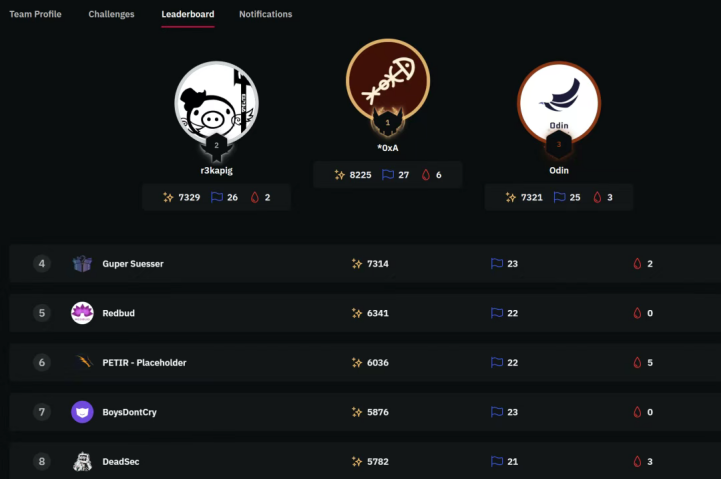
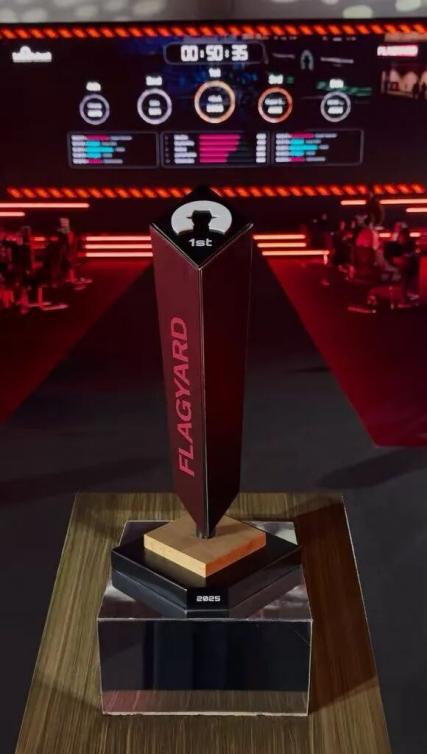
Recently, the BlackHat MEA CTF Final 2025 concluded successfully in Riyadh, Saudi Arabia. After three days of intense competition, the joint team *0xA—formed by Zhejiang University’s AAA team, Shanghai Jiao Tong University’s 0ops team, and Fudan University’s ****** team—stood out from the field and claimed the overall world championship with a commanding total score of 8,225.
A global stage in the spotlight
BlackHat MEA (the Middle East and Africa edition of Black Hat) is a globally recognized international conference in the cybersecurity industry, held annually in Riyadh. As one of the event’s flagship competitions, the BlackHat MEA CTF is designed to evaluate participants’ end-to-end technical capabilities in a realistic, hands-on environment. The contest attracts many of the world’s top security professionals and enthusiasts: more than 1,000 teams register each year, and after multiple rounds of qualifiers, 150 top-performing teams advance to the on-site finals at the Riyadh International Convention & Exhibition Center. Since the CTF began, the championship title has long been dominated by “multinational joint teams” from Europe and North America.
In this competition, Zhejiang University’s AAA team fielded two contestants from the College of Computer Science and Technology—Hu Jiayi and Hu Yicheng. He Haojie, an AAA member and a 2022 undergraduate alumnus of Zhejiang University’s Computer Science and Technology program who now serves as captain of Shanghai Jiao Tong University’s 0ops team, also traveled to Riyadh to compete.
A thrilling journey to the crowning victory
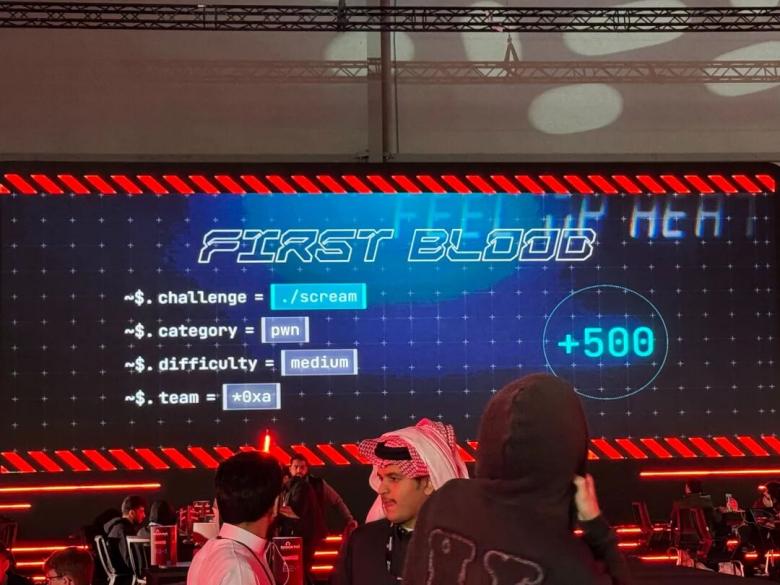
On day one, the team members focused on cryptography took the lead, solving all cryptography challenges in just one hour. For the kernel exploitation challenge “Scream,” Hu Jiayi leveraged extensive kernel security experience to crack the problem quickly, becoming the first team to solve it.
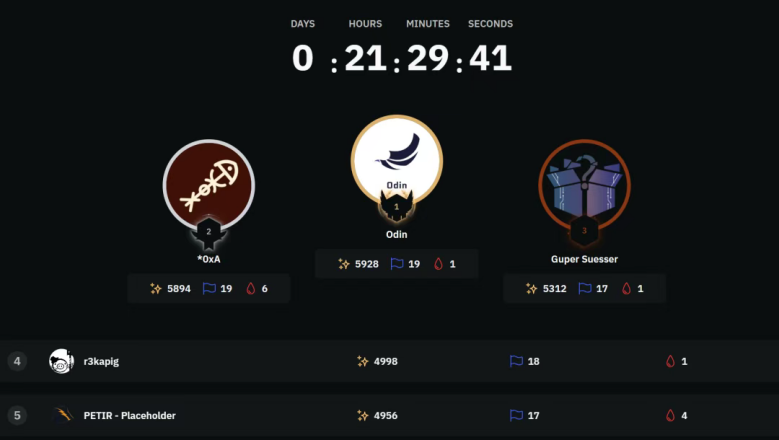
On day two, the competition intensified as several internationally renowned teams—such as Odin and r3kapig—closed in, and the score gap continued to shrink. The team secured first blood on the forensics challenge Between the Lines, the differential attack challenge Limeade, and the asymmetric cryptography attack challenge doloR Sit Amet. However, by the end of the day, they were still one final step away from solving three additional challenges, and the top spot was temporarily taken by South Korea’s Odin—prompting the joint team to resolve to go all out on the final day.
Once the final day began, the team went full throttle, quickly clearing every challenge that had at least one solve. In the final two hours—under “blackout mode,” where real-time scores were hidden—the team held intense discussions and successfully solved Ninja V2, an XSS exploitation challenge that had remained unsolved for a long time. That decisive breakthrough sealed the win, and they ultimately claimed the BlackHat MEA CTF 2025 world championship with an absolute lead of nearly 1,000 points.
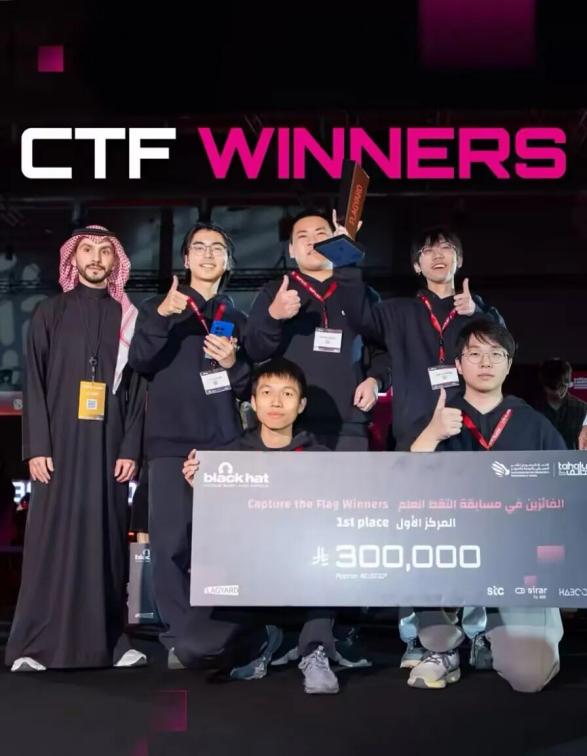
Before this BlackHat MEA CTF, the participants from the three universities had already fought side by side on the international stage and earned major honors together—such as a DEF CON championship—so they were already well attuned to one another’s pace and working style. That chemistry carries over into everyday collaboration as well: the three schools stay in close contact, co-organize campus CTFs and training activities, and some members have even gone from Zhejiang University to Shanghai Jiao Tong University for further study—making their partnership something that extends well beyond the competition itself.
More importantly, each of the three teams has strengths in different CTF domains, and together they complement one another perfectly—covering both strengths and weaknesses. When tough challenges arise, they can quickly divide tasks, collaborate, and cross-validate, combining their individual “strong suits” into a more complete capability matrix. Over three days of high-intensity competition, they pushed hard under pressure while also encouraging one another, creating a team dynamic that was both highly efficient and genuinely enjoyable. Looking ahead, the members from the three universities hope to continue competing together and, as *0xA, deliver even more standout results in international contests.
Looking to the future, Zhejiang University’s College of Computer Science and Technology will continue to build on its disciplinary strengths in cybersecurity and drive the training of high-caliber security talent through a “competition-integrated learning” approach—using contests to support learning and learning to elevate performance—so as to contribute to strengthening the foundation of a cyber powerhouse.